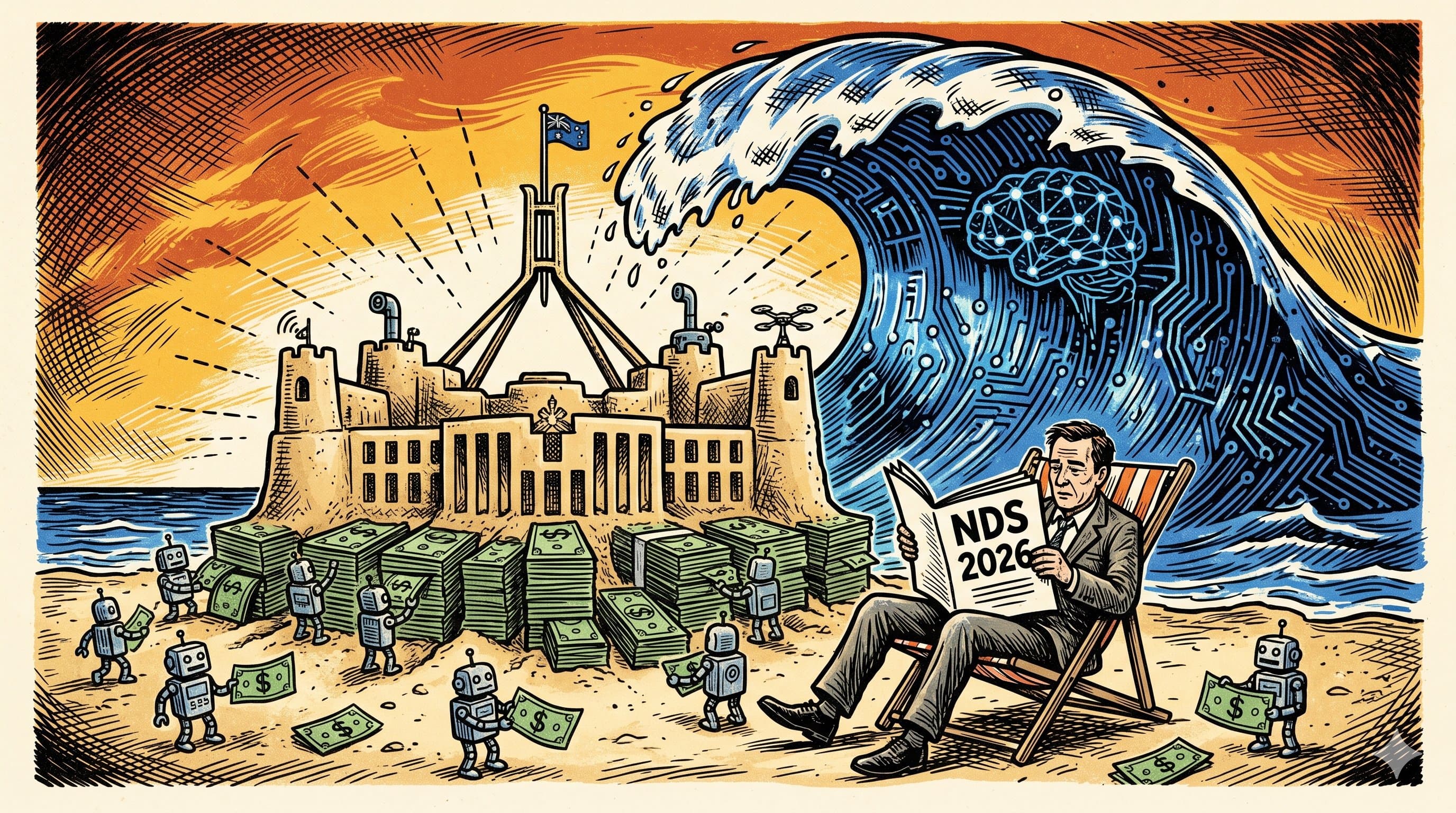

On 16 April 2026, Defence Minister Richard Marles stood at the National Press Club and announced the biggest peacetime defence investment in Australian history. Four hundred and twenty-five billion dollars in capability spending over a decade. Nuclear submarines. Autonomous drones. Hypersonic missiles. A force structure designed to deny any adversary the ability to project power against Australia through its northern approaches.
The strategy is serious. The threat assessment is sober. The money is real.
There is just one problem. The entire plan assumes the economy generating the tax revenue to fund it will still exist in its current form by 2035.
It will not.
The strategy everyone is debating
The 2026 National Defence Strategy does several things well. It acknowledges, in language Canberra rarely uses, that the rules-based order is "in transition" and that "the concept of deterioration is no longer adequate" to describe Australia's strategic environment. It broadens the definition of National Defence beyond the military to include fuel security, economic resilience, and civil preparedness. It commits to self-reliance in terms that would have been unthinkable five years ago.
The numbers are staggering. Total Defence funding reaches $887 billion over the decade. Annual acquisition spending nearly triples, from $19.2 billion today to $47.5 billion by 2035-36. Defence expenditure climbs to approximately 3 per cent of GDP by 2033-34, measured on the NATO methodology. The government calls it historic, and on this point the government is correct.
The commentary ecosystem is having the debate you would expect. Mick Ryan, writing on Substack, calls it "more ambition, same architecture." The Lowy Institute notes it "delivers more of the same." ASPI analysts argue about whether autonomous systems investment is sufficient. Defence Connect catalogues the platforms. Everyone is arguing about whether the strategy spends enough, on the right things, fast enough.
Nobody is asking whether the money will be there.
The fiscal foundation nobody mentions
Here is a number that does not appear anywhere in the 102 pages of the National Defence Strategy or the 118 pages of the Integrated Investment Program: 54 per cent.
That is the Parliamentary Budget Office's projection for personal income tax as a share of total federal tax receipts by 2032-33. Not corporate tax. Not GST. Not resource royalties. Personal income tax, paid by individuals who go to work, perform cognitive tasks, and deposit their earnings into bank accounts from which the ATO takes its share.
Australia's revenue model is, by developed-world standards, unusually dependent on a single tax instrument levied on a single activity: people working. The OECD average reliance on personal income tax is significantly lower. Most comparable economies have diversified their revenue base with broader consumption taxes, higher corporate tax takes, or resource-based revenue streams. Australia chose bracket creep as its primary fiscal repair mechanism and personal income tax as its primary revenue source.
This worked well when the workforce was stable. It works less well when the workforce is about to be restructured by the fastest technology transition in human history.
The 89-day clock
If you have read the Outpaced series, you know the number. METR, the independent AI evaluation organisation, measured autonomous AI task duration doubling every 89 days as of January 2026. Not capability. Not benchmark scores. The duration of tasks that AI systems can perform autonomously, without human intervention, is doubling every three months.
In the two months since the 2026 NDS was being finalised, AI systems have continued to improve at this rate. By the time the first epoch of the strategy's force structure reaches its target in mid-2028, autonomous AI agents will have doubled in capability approximately eight more times from today's baseline. By the time the "Future Integrated Force" is supposed to be delivered beyond 2030, the number of doublings enters territory where prediction becomes speculation and speculation becomes theology.
The NDS knows this is happening. Chapter 1, paragraph 1.23, states that "the most significant potential for technological disruption in the coming years may come from artificial intelligence, which is already transforming war and changing the role of human decision-making." Chapter 9 devotes a full callout box to AI in warfare, citing Ukraine's Griselda platform and AI-enabled targeting.
But here is the structural blind spot: the NDS treats AI exclusively as a military capability input. Drones. Autonomous undersea vehicles. AI-enabled command and control. The $12 to $15 billion allocated to uncrewed and autonomous systems. All of this is framed as what AI does for the ADF.
Not a single paragraph addresses what AI does to the economy that funds the ADF.
The fiscal threat the strategy ignores
The IMF released its April 2026 World Economic Outlook two days before the NDS launch. The timing is coincidental. The relevance is not.
Global growth has been cut to 3.1 per cent, down from 3.3 per cent before the US-Israel war on Iran began on 28 February. The severe scenario, assuming extended energy supply disruption and tighter financial conditions, projects growth of 2 per cent. The IMF called this "a close call for a global recession," noting that growth has been below that level only four times since 1980.
Oil prices are surging. The Strait of Hormuz, through which roughly 20 per cent of the world's oil and LNG travels, is under direct military pressure. Energy costs are feeding into inflation across every economy that imports fuel, which is all of them.
Now overlay the AI disruption timeline onto this macroeconomic picture.
The IMF estimated in January 2024 that 60 per cent of jobs in advanced economies are exposed to AI. Not "at risk of full replacement." Exposed, meaning AI will substantively alter the task composition, productivity requirements, or existence of those roles. Australia's services-dominated economy, where services contribute roughly 63 per cent of GDP, sits squarely in the exposure zone.
The workforce segment generating the most personal income tax revenue is managers, professionals, and administrative workers. This is also the workforce segment most exposed to AI displacement. The people paying for the submarines are the same people whose jobs are being automated.
If AI-driven disruption reduces personal income tax revenue by even 10 to 15 per cent during the 2028-2033 window, the NDS funding trajectory breaks. Not because of policy choice. Because of arithmetic.
The historical pattern nobody wants to remember
Australia has been here before. Not with AI, but with fiscal pressure meeting strategic ambition.
The Great Depression hollowed the Permanent Military Forces to a skeleton. Post-GFC fiscal consolidation drove defence spending to approximately 1.59 per cent of GDP in 2013-14, the lowest share since 1938. In both cases, the strategic environment was deteriorating. In both cases, the budget won.
Every Australian fiscal crisis in the past century produced defence cuts, regardless of what the threat assessment said. The question is not whether AI will create fiscal pressure. The question is whether this time will be different.
The NDS itself acknowledges the pattern indirectly. Paragraph 1.18 notes that "nations across the globe are reaching the same conclusion" about a more dangerous world and are "surging investment in their own defence capabilities." Paragraph 1.19 warns of "escalating defence costs across the globe, driven by supply chain pressures, infrastructure constraints and rising input costs."
What it does not say is that global defence cost escalation, combined with domestic fiscal erosion from AI, creates a pincer movement on the Australian defence budget. Costs go up. Revenue goes down. The $425 billion figure sits in the middle, looking increasingly optimistic.
The document contradicts itself
The NDS is, to its credit, the most AI-aware defence strategy Australia has produced. The callout box in Chapter 9 states plainly that AI is "a necessity for modern militaries seeking to remain operationally credible." It references Ukraine's use of AI for intelligence fusion, autonomous targeting, and rapid battle damage assessment. It allocates $12 to $15 billion for autonomous and uncrewed systems across air, maritime, and land domains.
It also contains a section on economic security (paragraph 2.8) that states "Australia's sovereignty, security and prosperity are inextricably linked and interdependent." This is precisely the Outpaced thesis, stated in the government's own words.
But the link runs in only one direction. The NDS asks how security supports prosperity. It never asks what happens to security when AI disrupts prosperity.
Chapter 5, on People, targets a permanent ADF of 69,000 by the early 2030s and a combined ADF-APS workforce of around 100,000 by 2040. These workforce targets exist in an economy where AI is simultaneously making cognitive labour cheaper, faster, and more scalable. The strategy assumes Defence will compete for talent in a stable labour market. It may instead be competing for talent in a market undergoing the most rapid restructuring since the Industrial Revolution.
What a recession does to defence strategy
The IMF's severe scenario is not a forecast. It is a warning. But recessions do not need to be global to damage Australian defence spending. A domestic recession, or even a sustained period of below-trend growth, combined with AI-driven PIT erosion, is sufficient.
Here is what happens: tax receipts fall short of forward estimates. Treasury revises down. The Expenditure Review Committee looks for savings. Defence, with its decade-long acquisition programs and multi-billion-dollar sustainment costs, presents the largest discretionary target in the federal budget. The submarines are contractually committed, so the cuts fall on readiness, sustainment, personnel, and the second-tier platforms that make the first-tier platforms effective.
This is not speculation. It is the documented pattern from every fiscal downturn Australia has experienced since Federation.
The 2026 NDS tries to pre-empt this by locking in the spending trajectory and establishing biennial strategy reviews. But no government can bind its successors to spending commitments when the revenue base shifts beneath them. The 2020 Defence Strategic Update promised $270 billion over its decade. Two years later, the 2023 Defence Strategic Review rewrote the force structure. Two years after that, the 2024 NDS increased to $330 billion. Now $425 billion. Each revision upward assumes the fiscal foundation holds.
The argument nobody is making
Every analyst evaluating the 2026 NDS is asking the same question: is this enough to deter China?
I want to ask a different question: what happens to this strategy if AI disrupts the Australian economy on the timeline the technology itself suggests?
The Outpaced thesis is straightforward. AI capability is accelerating on a measured, empirical trajectory. Australia's fiscal structure is uniquely vulnerable to AI-driven workforce displacement. When fiscal crises hit, defence budgets are cut. Therefore, AI poses a strategic threat to Australian defence capability not through military application but through economic disruption.
The 2026 NDS acknowledges two of the three elements. It sees AI as a military force. It sees economic security as linked to national defence. It does not see AI as the force that could undermine the economic security on which the defence strategy depends.
This is not a criticism of the strategy's military logic. The Strategy of Denial makes sense. The investment in autonomous systems is overdue. The emphasis on self-reliance is welcome. The broadening of National Defence to include fuel security and civil preparedness shows real strategic thinking.
But a $425 billion defence strategy that does not model the fiscal impact of the technology it identifies as transforming warfare is a strategy built on an assumption, not a foundation.
What needs to happen
The 2026 NDS is not wrong. It is incomplete.
Australia needs three things the strategy does not provide.
First, a concurrent fiscal resilience strategy that models AI's impact on the tax base and identifies alternative revenue mechanisms before the pressure arrives. This is not a defence task. It is a Treasury task. But the NDS should demand it, because without it the strategy's own funding pathway is at risk.
Second, an honest assessment of the speed mismatch between AI acceleration and defence acquisition. The NDS establishes three epochs, with the "Future Integrated Force" arriving beyond 2030. By that date, autonomous AI capabilities will have doubled approximately sixteen times from today. The force structure being designed today may be operationally obsolete before it is delivered. The NDS acknowledges "minimum viable capability" as a principle but does not apply it with the urgency the technology timeline demands.
Third, a workforce strategy that accounts for AI displacement across the national economy, not just within Defence. Chapter 5 targets 69,000 ADF personnel and 100,000 combined by 2040. These numbers assume a stable civilian economy from which Defence recruits. If AI restructures the civilian labour market, the recruiting calculus changes entirely, for better and for worse. Defence could find itself with a larger available pool of displaced workers, or it could find itself competing against AI-augmented private sector roles that pay more and demand less.
The $425 billion question
Forty-eight hours after the IMF warned the world might be approaching a global recession, Australia committed to the largest peacetime defence investment in its history. The strategy is designed for the most dangerous era since World War II. The capability logic is sound. The threat assessment is clear-eyed.
The fiscal assumption is not.
This is not a defence strategy with a funding gap. It is a fiscal assumption dressed as a defence strategy.
The question is not whether Australia should spend more on defence. It should. The question is whether the economic model generating the revenue to fund that spending will survive the very technology the strategy identifies as transforming the character of war.
The 2026 National Defence Strategy gives Australia a serious answer to the military question. It does not ask the economic question at all.
And the economic question is the one that decides whether the military answer matters.
Sources
- 2026 National Defence Strategy, Department of Defence, 16 April 2026
- 2026 Integrated Investment Program, Department of Defence, 16 April 2026
- World Economic Outlook, April 2026: Global Economy in the Shadow of War, International Monetary Fund
- War Darkens Global Economic Outlook and Reshapes Policy Priorities, IMF Blog, 14 April 2026
- More Ambition, Same Architecture: Australia's 2026 National Defence Strategy, Mick Ryan, Substack
- The 2026 National Defence Strategy delivers more of the same, Mick Ryan, Lowy Institute, 16 April 2026
- Trends in personal income tax, Parliamentary Budget Office
- 2025-26 Medium-Term Budget Outlook: Beyond the Budget, Parliamentary Budget Office
- METR Time Horizon Research Report, January 2026
- Australia Military Spending (% of GDP), World Bank
- Drones and other uncrewed capabilities to be a big feature of new National Defence Strategy, The Conversation, April 2026