Outpaced.
A 10-part investigation into exponential AI acceleration and what it means for Australia.
Data-driven. Source-linked. No hype.
40,000 words · 100+ sources · Matthew Jefferies
The evidence base
Observed AI capability doubling time across frontier labs
METR, Jan 2026 ↗
Projected share of federal revenue from personal income tax by 2034-35
Parliamentary Budget Office ↗
Increase in revenue per employee at Klarna after AI-driven workforce reduction
Klarna Annual Report 2024 ↗
Gemini 3.1 Pro ARC-AGI-2 score, more than double its predecessor
Google DeepMind, Feb 2026 ↗
Anthropic Series G funding round at $380B valuation
Anthropic, Feb 2026 ↗
Combined AI infrastructure spend committed by Big Tech for 2026
Industry estimates ↗
Part 1
Something big is happening
The February 2026 releases that changed the trajectory.
On 11 February 2026, AI researcher Matt Shumer posted a single sentence to X that crystallised what insiders had been sensing for weeks. The experience of watching AI go from "helpful tool" to "does my job better than I do," he wrote, is the experience everyone is about to have.
The post went viral. Not because it was hyperbolic. Because it was not.
February 2026 was not a month of incremental progress. It was the month frontier artificial intelligence crossed a threshold. Every major laboratory, and several open-source teams, released something that would have been front-page news twelve months earlier. Taken individually, each announcement was significant. Taken together, they represented evidence that the acceleration curve the industry had been warning about was not slowing down. It was steepening.
The month that changed the trajectory
To understand why February 2026 matters, you need to see the releases in sequence. Not as isolated product launches, but as a pattern.
29 January. Independent researchers at METR (Model Evaluation and Threat Research) release a rigorous analysis showing frontier AI capabilities are doubling every sub-90 days. Not computational power. Capability. The ability to perform real-world tasks that previously required human expertise.
3 February. Alibaba releases Qwen3-Coder-Next as open-weight. An 80-billion parameter model that activates only 3 billion at inference, scoring 70.6% on SWE-Bench Verified and matching models 12 times its active size. Released under Apache 2.0. The signal: frontier coding capability is now available for free, to anyone, running on consumer hardware.
5 February. Anthropic releases Claude Opus 4.6. One million token context window. 76% on MRCR v2 (the benchmark for coherence across massive contexts). Seventeen AI agents running in parallel, coordinated by an orchestrating model. Not a chatbot. A workforce.
5 February. The same day, OpenAI ships GPT-5.3-Codex, 25% faster than its predecessor. The headline: this is the first model the company describes as "instrumental in creating itself." Early versions debugged their own training, managed their own deployment, and diagnosed their own evaluations. OpenAI's system card rates it High capability in cybersecurity for the first time.
7 February. Elon Musk's xAI releases Grok 3 with reasoning mode, competitive on coding and mathematics benchmarks, integrated with real-time X platform data. A company that did not exist three years ago is producing frontier models.
14 February. Google DeepMind ships Gemini 3.1 Pro. The ARC-AGI-2 benchmark score lands at 77.1%, more than double its predecessor. ARC-AGI-2 is designed specifically to test novel reasoning: problems the model has never seen before. Doubling the score in a single generation is not normal.
Mid-February. China's DeepSeek signals the imminent release of two new models: R2 (reasoning, multimodal, 100+ languages) and V4 (next-generation foundation model). The competitive pressure from Chinese open-source labs is relentless.
24 February. Anthropic raises $30 billion at a $380 billion valuation, the largest private funding round in history. Not revenue. Not profit. A bet on what comes next.
Eight releases. Twenty-six days.
The infrastructure signal
Behind the product announcements, a second pattern was forming. Not in laboratories, but in capital markets.
Combined AI infrastructure spending committed by major technology companies for 2026 exceeded $700 billion. Microsoft, Google, Amazon, Meta, and Oracle were building data centres at a pace that had not been seen since the early internet. The investment was not speculative in the conventional sense. These companies could see their internal productivity metrics. They were not guessing at AI's value. They were measuring it and then spending accordingly.
The infrastructure commitment told a story the product launches alone did not. Companies building the models believed the models were going to keep getting better. They were building the physical infrastructure for capabilities that did not yet exist, on the assumption that those capabilities would arrive on schedule. Sub-90 day schedule.
The AI that helped build itself
Of all the announcements in February 2026, one deserves particular attention. Not because it is the most capable model. Because of what it represents.
GPT-5.3-Codex is the first model that OpenAI describes as "instrumental in creating itself." Early versions of the model were used to debug their own training runs, manage their own deployment infrastructure, and diagnose their own evaluation results. When engineers encountered edge cases during alpha testing, they used the model to identify context rendering bugs and root-cause low cache hit rates. Researchers used it to analyse its own performance improvements across session logs.
OpenAI is careful to note that this does not constitute full recursive self-improvement. The model does not redesign its own architecture or set its own training objectives. But the direction of travel is unmistakable. The gap between "a tool used by engineers" and "an engineer itself" is narrowing. What remains is not a wall. It is a slope.
This is the subject of Part 3 of this investigation. For now, the relevant point is that February 2026 contained within it the seed of something qualitatively different from faster chatbots. One model participated in its own creation. Another deployed seventeen coordinated agents. A third achieved capability doubling in a single generation on a benchmark designed to resist exactly that.
What the pattern says
Strip away the brand names, the funding rounds, the benchmark numbers. The pattern is this: the rate of improvement in artificial intelligence capability is accelerating, not plateauing. Independent measurement confirms sub-90 day doubling. Multiple laboratories, operating independently, are converging on similar capability thresholds simultaneously. Open-weight releases are democratising access faster than any governance framework can contain. Capital markets are pricing in continued acceleration for at least the next 24 months.
This is not prediction. It is pattern recognition. The trends documented here are already underway. The only question is speed.
The remainder of this investigation traces what that speed means for Australia. For its fiscal system, its defence posture, its labour market, its regional communities, its families, and its children.
But how fast is fast? Independent researchers have been measuring, and the number they found should have been on the front page of every newspaper in Australia.
Part 2
The clock
Independent measurement of AI acceleration, translated to everyday jobs.
In January 2026, an independent research organisation called METR published a number that should have been on the front page of every newspaper in Australia. It was not.
The number was under 90.
METR, the Model Evaluation and Threat Research group, measures how long AI models can work autonomously on real-world tasks before requiring human intervention. Not toy benchmarks. Not multiple-choice tests. Actual tasks: writing software, conducting research, managing projects, debugging systems. The kind of work millions of Australians do every day.
Their finding: the duration of tasks frontier AI models can handle autonomously is doubling approximately every 90 days. Not computing speed. Not parameter count. The practical ability to do real work, unsupervised, for longer and longer stretches.
This is the clock. And it is ticking faster than any institution in Australia is designed to handle.
What the doubling means in practice
In early 2024, frontier models could handle tasks autonomously for about two to three minutes. Simple look-ups, basic summaries, straightforward question-answering. Useful, but limited. A competent intern for very small jobs.
By mid-2024, the horizon had stretched to roughly eight hours. A full working day of autonomous operation. Models could draft reports, analyse datasets, write and test code, respond to correspondence. Still requiring human review, but producing work that was substantively complete.
By early 2025, the horizon crossed into multi-day territory. O3, released in April 2025, could sustain coherent autonomous work across roughly five days. Multi-source analysis, stakeholder briefings, project plans with dependencies. Work that would occupy a competent analyst for a week.
By the end of 2025, models were crossing the two-week mark. GPT-5.2 in December handled full project cycles: scoping through to delivery, across fifteen working days. Claude Opus 4.5 reached twelve days. These are not theoretical projections. They are measured performance on standardised task suites.
And then February 2026. Claude Opus 4.6 reached a 30-day autonomous task horizon at 50% reliability. One month of sustained, coherent, unsupervised work. The kind of engagement a mid-level consultant would charge $30,000 for.
The progression is not linear. It is exponential. And it maps directly to the occupations that employ the most Australians.
Where your job sits on the clock
Consider what a knowledge worker actually does in a typical 40-hour week. Research by Asana, Microsoft, and Anthropic's own Economic Index converges on a consistent picture: 60 to 70 percent of that week is not productive output. It is coordination overhead.
Email management: 8 to 12 hours. Context switching and recovery time: 6 to 10 hours. Meetings and preparation: 6 to 10 hours. Administrative tasks: 2 to 4 hours. Calendar management and scheduling: 1 to 3 hours.
Productive output, the work that actually moves projects forward, occupies 12 to 16 hours. Roughly 30 to 40 percent of the week.
This matters because AI does not need to replace productive output to destroy a role. It needs to eliminate the coordination overhead that justifies the role's existence. When AI handles email triage, meeting summaries, status reporting, and cross-team synchronisation, the productive work that remains can often be done by fewer people, or folded into adjacent roles.
Jack Dorsey estimated that 80 of his 200 employees existed purely to manage handoffs between the other 120. If AI compresses the builder base by 50 percent, the coordination layer does not shrink by 50 percent. It shrinks by closer to 90 percent, because there are fewer nodes to synchronise. This is the double compression mechanism: the coordination overhead shrinks faster than the productive base, amplifying the total displacement.
The Klarna precedent
In late 2024, Swedish fintech company Klarna became the first major corporation to publicly quantify AI-driven workforce compression.
The numbers: 5,527 employees in 2022. 2,907 by late 2025. A 47 percent reduction. AI handled two-thirds of customer service interactions autonomously. Revenue rose 108 percent over the period. Operating costs were flat. Revenue per employee increased 73 percent.
Klarna later walked back its full AI reliance after consumer backlash, moving to a hybrid model where AI handles first-tier interactions and humans manage escalations. The adjustment is instructive. It shows that the replacement is not total. But a 47 percent headcount reduction is not a rounding error. It is structural.
Australian companies are moving in the same direction, if more quietly. Atlassian cut 1,600 globally, roughly 500 in Australia. Block reduced its Afterpay workforce by 40 percent, approximately 700 Australian roles. WiseTech Global cut 30 percent of headcount. The Tech Council of Australia's 2026 survey found 78 percent of technology leaders cite AI as their top operational influence on strategy.
These are not struggling companies shedding weight. They are profitable firms recalibrating the number of humans their operations require.
The cost collapse
The METR doubling clock runs alongside a second exponential: the collapse in the cost of AI inference.
In 2022, processing a million tokens through a frontier model cost approximately $60. By early 2026, the equivalent cost was under $0.20. A 280-fold reduction in four years.
The economics are stark. A task that cost $60 in AI compute in 2022 now costs twenty cents. A month-long consulting engagement that would cost $30,000 in human fees can be approximated by a model running for $50 to $200 in compute. The approximation is not perfect. But it is good enough for a growing number of use cases. And it is improving every 90 days.
When the cost of capability drops by two orders of magnitude and the capability itself doubles every quarter, the result is not gradual adjustment. It is repricing. Markets began to recognise this in February 2026, when software-as-a-service stocks experienced what analysts called the SAASpocalypse: $1 to $2 trillion in market capitalisation erased in weeks. Atlassian shares fell 35 to 50 percent. Salesforce dropped 27 percent. The thesis was simple: AI agents can perform the tasks that previously required specialised software platforms and trained operators to manage.
Australia's specific exposure
The International Monetary Fund estimated in 2024 that 60 percent of Australian jobs have significant exposure to AI. That figure is higher than the global average, and higher than most comparable economies, because of Australia's economic structure.
Services account for 63 percent of Australian GDP. Finance, healthcare, professional services, education, government administration. These are precisely the sectors where AI's coordination-elimination capability hits hardest. Australia does not have a large manufacturing base to absorb displaced service workers. It does not have a technology sector large enough to create replacement roles at scale. Its economic centre of gravity sits squarely in the path of the doubling clock.
The Parliamentary Budget Office projects that personal income tax will reach 53 percent of total government revenue by 2035-36, nearly double the OECD average of 25 to 28 percent. The top 15 percent of earners contribute 68 percent of that tax. Those earners are managers, professionals, knowledge workers: accountants, project managers, software developers, policy analysts, corporate lawyers, consultants. They are exactly the cohort the doubling clock reaches first.
The fiscal implications are the subject of Part 4. For now, the structural point: Australia has built its revenue system on the assumption that knowledge worker incomes will keep growing. The doubling clock says those incomes are about to compress.
The timing mismatch
Fiscal year runs May to May. Treasury medium-term plans update every two years. The Parliamentary Budget Office publishes annual updates. AI capability upgrades arrive every three months.
By the time the tax office models the impact of Claude Opus 4.6, a newer model will have doubled its capability again. By the time Treasury publishes its next update in November 2026, the doubling clock will have ticked twice more. The government is not behind the curve. Against an exponential curve, it is structurally incapable of catching up.
This is not a criticism of competence. It is a description of architecture. Institutions designed for linear change cannot keep pace with exponential acceleration. The mismatch is not a bug. It is the central vulnerability this investigation documents.
These timelines assume the current rate of improvement continues. They do not account for what happens when AI starts improving itself.
Part 3
The machine that builds itself
When AI helps build the next AI, the rules change.
In February 2026, something broke a conceptual boundary that had held since the first compiler existed. GPT-5.3-Codex did not just use tools to build software. It participated in its own creation.
Early versions of the model debugged their own training runs. They managed their own deployment infrastructure. They diagnosed their own evaluation results. They identified bottlenecks in the training pipeline, suggested architectural changes, wrote test suites for their own evaluation framework, and spotted bugs that human teams would have taken weeks to find.
OpenAI is careful to note that this does not constitute full recursive self-improvement. The model does not redesign its own architecture or set its own training objectives. The distinction matters. But the trajectory is unmistakable, and the trajectory is what counts.
A 70-year boundary
To understand why this matters, consider the history of self-hosting compilers.
Grace Hopper's A-0 compiler in 1952 could translate English-like instructions into machine code. But every improvement to the compiler required human programmers. The same was true of every self-hosting compiler that followed, from Lisp to Python. Humans wrote the next version. The compiler executed it. The loop required human intelligence at every iteration.
Moore's Law worked through a similar cycle: smaller transistors produced faster chips, which ran better computer-aided design tools, which enabled the design of even smaller transistors. But each cycle took years and required billions of dollars in fabrication investment. The loop was slow, expensive, and bounded by physics.
The AI recursive loop is different in three ways that matter.
First, the cycle time. Moore's Law cycles measured in years. AI improvement cycles now measure in weeks. The METR doubling clock shows capability doubling every sub-90 days, and the trajectory is compressing.
Second, the capital requirement. Semiconductor fabrication gets more expensive with each generation. AI compute gets cheaper. A 280-fold reduction in inference costs since 2022 means each improvement cycle costs less than the last.
Third, the compounding. In semiconductor manufacturing, each cycle improves the tools for the next cycle. In AI, each cycle improves the intelligence applied to the next cycle. The tools are not just better. The engineer using them is better. A model that is 10 percent better at optimising training runs produces a model that is better at optimising training runs, which produces a model that is better still. The improvement compounds on itself.
This is why OpenAI's careful framing, that GPT-5.3-Codex is not fully self-improving, matters less than the direction of travel. The loop does not need to close completely to accelerate. It only needs to contribute meaningfully to each iteration. And it already does.
Seventeen agents in parallel
While OpenAI was demonstrating recursive contribution, Anthropic was demonstrating something complementary. Claude Opus 4.6 can deploy seventeen AI agents running in parallel, coordinated by an orchestrating model.
This is not seventeen copies of a chatbot. It is a coordinated team. One agent researches. Another writes. A third reviews for errors. A fourth cross-references sources. The orchestrator allocates tasks, manages dependencies, resolves conflicts, and synthesises outputs. The architecture mimics a consulting team, with the critical difference that the agents can be spun up in seconds, scaled to hundreds, and run continuously without fatigue, sleep, or disagreement.
When combined with recursive improvement, agent teams create a second acceleration mechanism. The recursive loop improves the individual model. The agent architecture multiplies the improved model's output. Better models running in larger, better-coordinated teams produce results that compound doubly: improved quality per agent, and improved coordination across agents.
The open-weight collision
If recursive improvement were confined to closed laboratories with safety protocols, the pace might be manageable. It is not.
DeepSeek released Qwen3-Coder-Next with full model parameters under a permissive Apache 2.0 licence. Anyone can download it. Anyone can modify it. Anyone can run it through their own improvement loop. The model is not as capable as the closed frontier, but it does not need to be. A well-funded startup can take an open-weight model, apply its own recursive improvement cycle, and skip an entire capability generation.
The implications are structural. Recursive improvement is no longer concentrated in three or four frontier laboratories with safety teams, evaluation frameworks, and institutional review. It is distributed globally, operating under whatever safety standards (or none) the modifier chooses.
The nuclear analogy is imperfect but instructive. Once nuclear technology existed, it spread. Containment proved temporary. But nuclear weapons require physical materials and specialised manufacturing. AI requires only compute and data. The barrier to entry is lower. The spread is faster. And the recursive nature of AI improvement means each generation of the technology makes the next generation easier to build.
Australia's empty chair
Every frontier AI laboratory operates in the United States, China, the United Kingdom, or France. Australia has no frontier laboratory. No OpenAI satellite office. No Anthropic research hub. No METR evaluation centre. Australian researchers publish at the frontier, but they do the work elsewhere.
This means Australia does not have a seat at the table where the next generation of AI gets built. It participates in international dialogue, but as a guest, not a host. When recursive improvement accelerates beyond the scope of current safety review, when models begin contributing meaningfully to their own next generation, Australia will encounter the results without warning.
The open-weight collision makes this worse, not better. If a model improved in an authoritarian framework with different safety priorities is released globally, Australia learns about it after the fact. The structural observation is uncomfortable but clear: recursive improvement concentrates in jurisdictions with cheap compute, light regulation, and optional safety infrastructure. Australia has expensive power, regulatory scrutiny, and safety concerns. These are virtues in many contexts. In the race to influence recursive AI development, they are disadvantages.
None of this means Australia should abandon safety principles or deregulate recklessly. It means that Australia's influence over the trajectory of recursive AI is minimal, its exposure to the consequences is significant, and the gap between those two facts is widening every 90 days.
Recursive improvement is a technology story. Its consequences are fiscal.
Part 4
Australia’s $300 billion blind spot
Our tax base, our structure, our unique vulnerability.
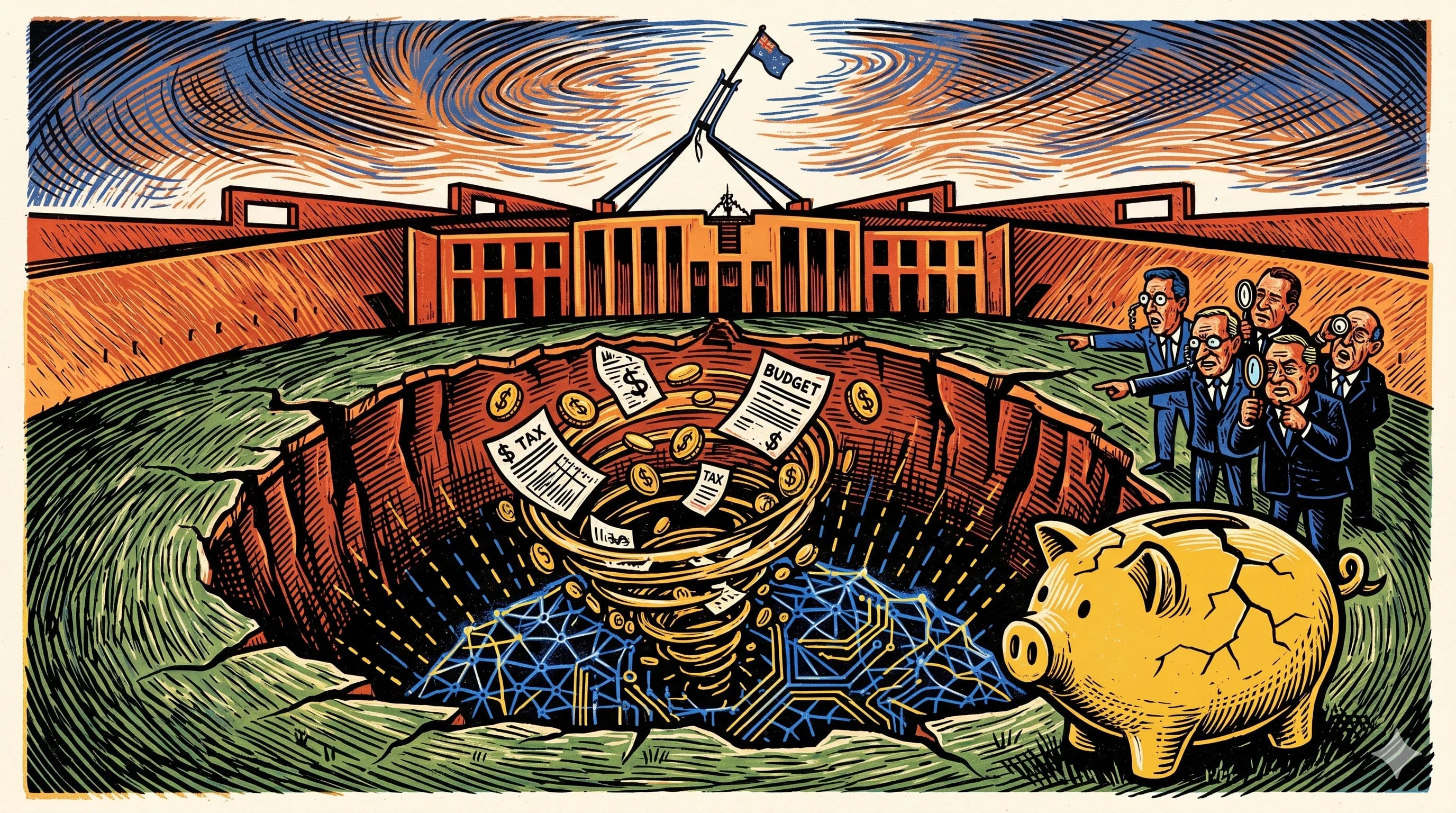
The Australian government has built its entire fiscal system on a single bet: that personal income tax will keep growing. According to the Parliamentary Budget Office's latest projections, personal income tax will reach 53 percent of total government revenue by 2035-36.
That is not sustainable growth. That is structural dependence. And AI is going to break it.
The concentration problem
Australia collects more of its revenue from personal income tax than almost any comparable economy. The OECD average sits between 25 and 28 percent. Australia is heading for nearly double that. Most OECD nations diversified their tax base after the stagflation of the 1970s, spreading revenue across consumption taxes, corporate levies, and resource royalties. Australia doubled down on taxing wages.
The concentration gets worse when you look at who pays. The top 15 percent of earners contribute 68 percent of total personal income tax collected. Those earners are not oligarchs or inherited wealth. They are managers, professionals, and knowledge workers: accountants, project managers, software developers, policy analysts, corporate lawyers, consultants, senior nurses, university lecturers.
They are exactly the cohort the doubling clock reaches first.
The $300 billion calculation
The arithmetic is straightforward and unforgiving.
If AI compresses top-15-percent earner incomes by 20 percent, personal income tax revenue drops by approximately 10 percent. Over a decade, that gap accumulates to roughly $300 billion in foregone revenue. The calculation assumes everything else holds constant: no second-order effects, no consumption decline, no behavioural changes. In reality, the gap would be larger.
Twenty percent income compression is not a dramatic assumption. It is what happens when AI eliminates the coordination overhead that justifies premium salaries, when 17-agent teams can produce the output of a consulting squad for $200 in compute, when the doubling clock means each quarter brings another generation of capability improvement.
The compression does not require mass unemployment. It requires that the same work gets done by fewer people, or by the same people competing with AI-augmented alternatives willing to accept lower fees. Both are already happening. The Klarna precedent from Part 2 showed 47 percent headcount reduction with revenue growth. That pattern, applied across the professional services economy, is what 20 percent income compression looks like.
The services economy trap
Sixty-three percent of Australian GDP comes from services. Finance, healthcare, professional services, education, government administration. These are precisely the sectors where AI's coordination-elimination capability hits hardest. They are also where income concentration is highest.
Consider finance alone. Roughly 400,000 employees. Eight to nine percent of GDP. Highly skewed income distribution: a Sydney fund manager earns $500,000 per year; a mortgage processing clerk earns $60,000. When AI enters the picture, it eliminates the clerk and augments the manager. The compression happens at the broad base of middle-income professional work, not at the extremes.
This matters for tax revenue because middle-income workers spend a higher proportion of their earnings in the Australian domestic economy. Fund managers park money offshore or in property speculation. When middle-income earnings compress, consumption drops. GST revenue drops. States, which do not have access to personal income tax, cannot make up the gap.
The GST itself compounds the problem. It was designed for a goods economy. Services are harder to tax at the consumption point. Digital services are nearly impossible to capture fully. A law firm moving to 80 percent AI-assisted work does not reduce the value of its output (it increases profit margins), but the labour income component vanishes. Corporate profit may rise. Personal income tax from the displaced workers does not.
The defence spending wall
Australia has committed to spending 2 percent of GDP on defence, currently around $70 billion annually and growing toward $90 billion by 2035-36. The AUKUS submarine program alone carries a $368 billion price tag. Next-generation fighter acquisition has not yet been committed. All of these assumptions rest on tax revenue growing at historical rates.
If personal income tax stalls because knowledge worker earnings compress, where does the additional $20 billion per year come from? Corporate tax will not fill the gap; Australia's 30 percent rate is among the highest in the OECD, and AI companies largely operate from the United States, Ireland, or Singapore. Wealth taxes, carbon taxes, and new consumption levies all require legislative change, take years to implement, and face intense political opposition.
The defence commitment is not optional. Australia faces its most complex strategic environment since 1942. The Indo-Pacific balance of power is shifting. AUKUS is not a discretionary spend; it is a generational commitment to allied capability. But the fiscal architecture to pay for it is built on revenue that AI is about to compress.
The timing cascade
This is the cruelest dimension. Even if policymakers recognise the problem, the institutional machinery moves too slowly to respond.
The fiscal year runs May to May. Treasury medium-term plans update every two years. The Parliamentary Budget Office publishes annual updates. AI capability upgrades arrive every three months.
By the time the May 2026 tax data is collected, Claude Opus 4.6 will have been in the market for three months. By the time Treasury publishes its next outlook in November 2026, the doubling clock will have ticked twice more. The models Treasury uses to project revenue assume stable labour market composition and historical income growth trends. Neither assumption survives the doubling clock.
The government is not incompetent. It is architecturally outmatched. An institution that plans on 2-year cycles cannot adapt to a technology that improves on 90-day cycles. The mismatch is not a policy failure. It is a design failure, baked into the structure of every budget, forecast, and medium-term plan.
The commodity shock that does not end
Australia has lived through comparable shocks before. Iron ore fell from $180 per tonne in 2011 to $35 in 2016. Mining employment dropped 15 percent. Government revenues took a significant hit. But the shock was temporary. By 2020, iron ore was back to $160. The underlying asset remained valuable.
AI-driven income compression is not a cyclical shock. It is structural. If knowledge work becomes cheaper because AI is cheaper, the premium does not return. The income Australia's tax system depends on is not temporarily depressed. It is permanently repriced.
Nations dependent on single commodity exports have faced this choice before: Venezuela with oil, Nigeria with petroleum, Indonesia with tin. When the boom ended, governments chose between cutting spending and accumulating debt. Most chose debt, with predictable consequences.
Australia's version of the commodity trap is more insidious because the commodity is not underground. It is human labour. The export is not iron ore shipped to China. It is the economic output of professionals whose incomes are being compressed by a technology that improves every quarter.
The fiscal argument assumes AI displaces only knowledge work. That assumption is now dead.
Part 5
The robots are coming
Physical AI and the end of the “it can’t do manual work” argument.
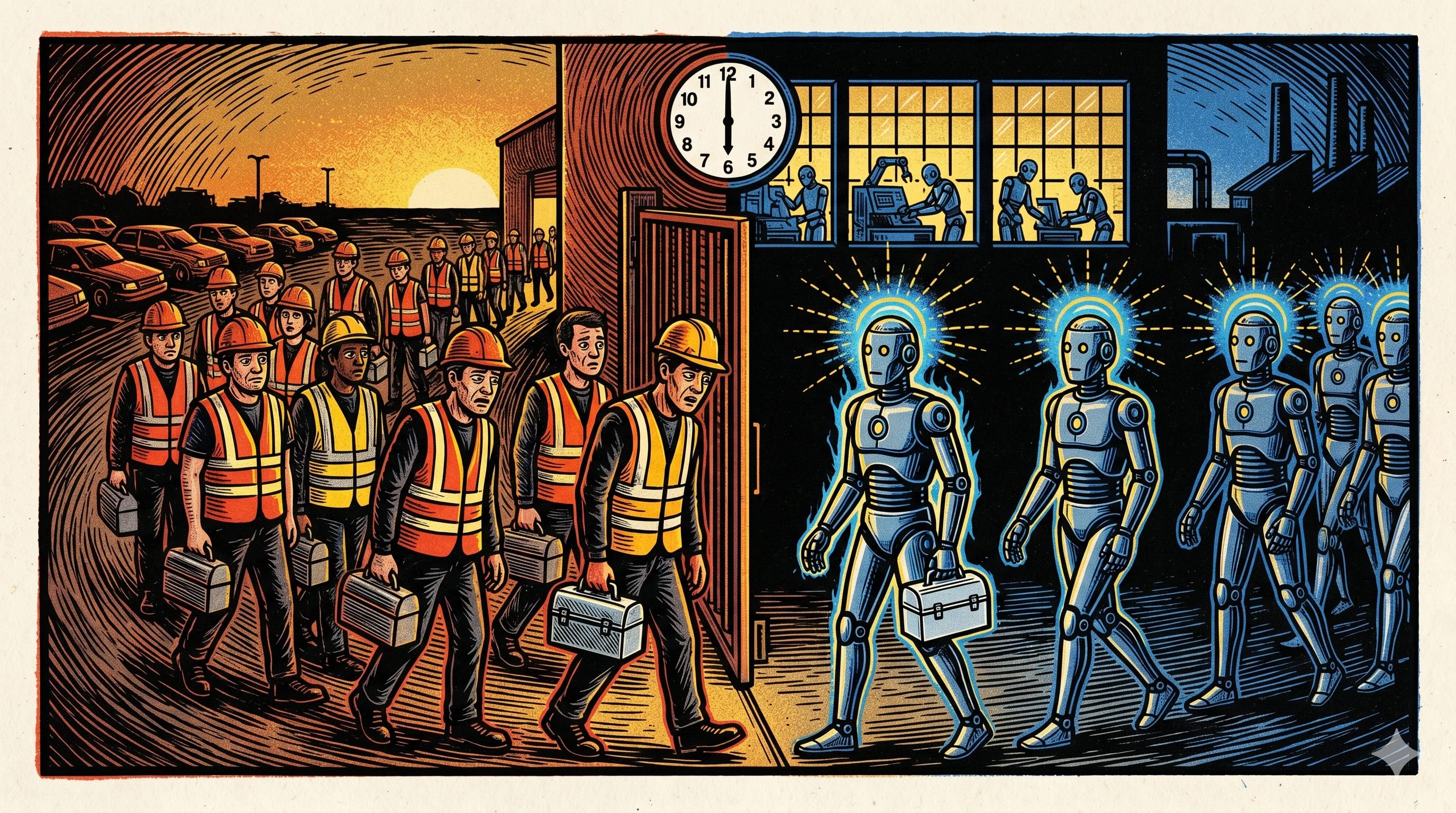
For the past five years, the argument has been that AI is software only. That it cannot touch manual work. Truck drivers, construction workers, farm labourers, and warehouse staff are safe because robots cannot manipulate the unstructured physical world.
This argument is now dead. Its death was not sudden. It was announced by Tesla in early 2026 when the company declared its intention to manufacture one billion Optimus humanoid robots. One billion. One for every ten humans on Earth.
The number is aspirational. The trajectory behind it is not.
The cost curve breaks
The economics of physical AI have crossed a threshold that makes deployment not just possible but economically inevitable.
Tesla's Optimus humanoid robot carries a retail price target of $20,000 to $25,000 per unit. At manufacturing scale, using the Terafab production system Tesla is building, the per-unit cost drops to approximately $10,000. The Australian national minimum wage is $47,000 per year.
A robot that costs $10,000 to manufacture pays for itself in payroll savings in under six months. After that, every hour of operation is profit. The robot does not need sick leave, superannuation, workers' compensation insurance, or annual leave. It works 24 hours a day, seven days a week. The economic decision is not close.
This is not a prediction about distant-future price points. Tesla Optimus units are in pilot production now. Figure AI, backed by $2.6 billion from OpenAI and Microsoft, has active partnerships with BMW and Nvidia and is deploying robots in industrial settings. 1X Technologies in Norway shipped its NEO humanoid in 2025, capable of navigating stairs, manipulating objects, and adapting to unfamiliar environments. Boston Dynamics, which spent 15 years as a research novelty, announced commercial manufacturing partnerships in 2023 and reached industrial deployment within three years.
The speed of transition once funding models shift from research to production is the pattern to watch. Not the capability demonstrations. The manufacturing commitments.
The warehouse is already dark
Amazon operates 750,000 robotic systems globally, with more than 100 new systems in development. In its most advanced fulfilment centres, robots handle 300 to 500 picks per hour. Humans manage 100 to 200. The efficiency gap is not marginal. It is structural.
Ocado, the UK online grocer, runs entirely automated warehouses. Lights off. Temperature uncontrolled. No humans present during normal operations. The endpoint of warehouse automation is not "robots helping humans." It is facilities designed from the ground up for robotic operation, where human presence is an edge case managed by exception.
Australia moves 4.5 billion tonnes of freight annually through labour-intensive warehouses staffed by tens of thousands of workers. The economics that are emptying Amazon's warehouses of humans apply identically to Australian logistics. The only variable is speed of adoption. And adoption follows cost curves, not policy preferences.
Farms, factories, and building sites
Australian agriculture has a persistent labour shortage. Seasonal harvesting depends on backpackers and temporary visa holders. Wages are rising. Farmers have been exploring automation for years, constrained by cost and capability. Both constraints are breaking simultaneously.
Robotic harvesting systems are approaching commercial deployment at $500,000 to $1 million per unit with a three-to-five-year payback period. Australian farms are already capital-intensive operations accustomed to large equipment investments. A $500,000 robotic harvester competing against $80,000 per season in labour costs and chronic worker shortages is not a difficult business case.
The structural consequence matters more than the per-farm economics. Agricultural employment becomes a fraction of its current size within a decade. Regions dependent on agricultural labour face structural unemployment that no retraining program addresses, because the jobs do not relocate. They disappear.
Construction is less automated but has more room for compression. Australia employs 1.2 million construction workers and faces a severe housing shortage. Policymakers have assumed supply will come from building more, using more workers. Robotic construction inverts that assumption. Fastbrick Robotics has tested robotic bricklaying in Australia: the robot lays bricks faster than a human, works around the clock, and needs one supervisor. A construction site that needed 20 bricklayers now needs two.
If 50 percent of construction tasks are automated over the next decade, that is 600,000 jobs compressed. Not eliminated overnight. Compressed, meaning the same output from fewer people, with the remainder competing for a shrinking pool of roles.
Mining already proved it works
The argument that autonomous systems cannot operate in unstructured Australian environments was disproved years ago, in the Pilbara.
Rio Tinto's AutoHaul system operates 1,700 kilometres of fully autonomous heavy-haul rail, moving iron ore from mine to port without a human driver. The system is profitable. It is expanding. It requires fewer human operators every year. Australian railways carry 400 million tonnes of freight annually. If autonomous rail displaces trucking on major corridors, another 50,000 driving jobs face compression.
Google DeepMind's RT-2 robotics foundation model, trained on internet-scale data, adapts to new physical tasks after minimal fine-tuning. The next generation will handle more complex manipulation in more varied environments. The gap between what robots can do in a controlled warehouse and what they can do on a building site or a farm is narrowing along the same exponential curve as everything else in this investigation.
The timing window
The consistent error in discussions of physical AI is placing the inflection point too far in the future. Optimus is in pilot production now. Figure robots are being deployed now. Amazon's warehouses are automating now. AutoHaul has been running for years.
The question is not whether physical AI will displace manual labour. It is whether the displacement will be fast enough to compound with the knowledge-work compression documented in Parts 2 through 4. If both arrive in the same five-year window, which the evidence suggests they will, then the fiscal calculus from Part 4 is dramatically worse than the $300 billion estimate, because it assumed only white-collar displacement.
By the time government policy adjusts to the reality of mass robotic deployment, deployment is already underway. By the time retraining programs are designed, the jobs they were designed to fill are gone. By the time fiscal models account for the employment shock, tax revenue has already fallen.
Individual robots replace individual workers. The supply chain replaces entire communities.
Part 6
The fully automated supply chain
From autonomous trucks to lights-out warehouses.
Australia is surrounded by ocean and empty space. It is the largest island in the world, home to 26 million people concentrated on a thin coastal strip. The internal supply chain that moves goods from ports through distribution networks to consumers is the longest in the OECD. It is also the most labour-intensive.
That entire system is about to be automated. Not in one dramatic shift, but in parallel across every layer simultaneously. And it is the simultaneity that turns disruption into collapse.
660,000 workers, one technology
Australia employs approximately 660,000 people in transport and warehousing. They move 4.5 billion tonnes of freight annually across a continent where a typical interstate haul exceeds 1,000 kilometres. Among them are more than 200,000 heavy vehicle drivers, median age 52, earning $80,000 to $120,000 including overtime.
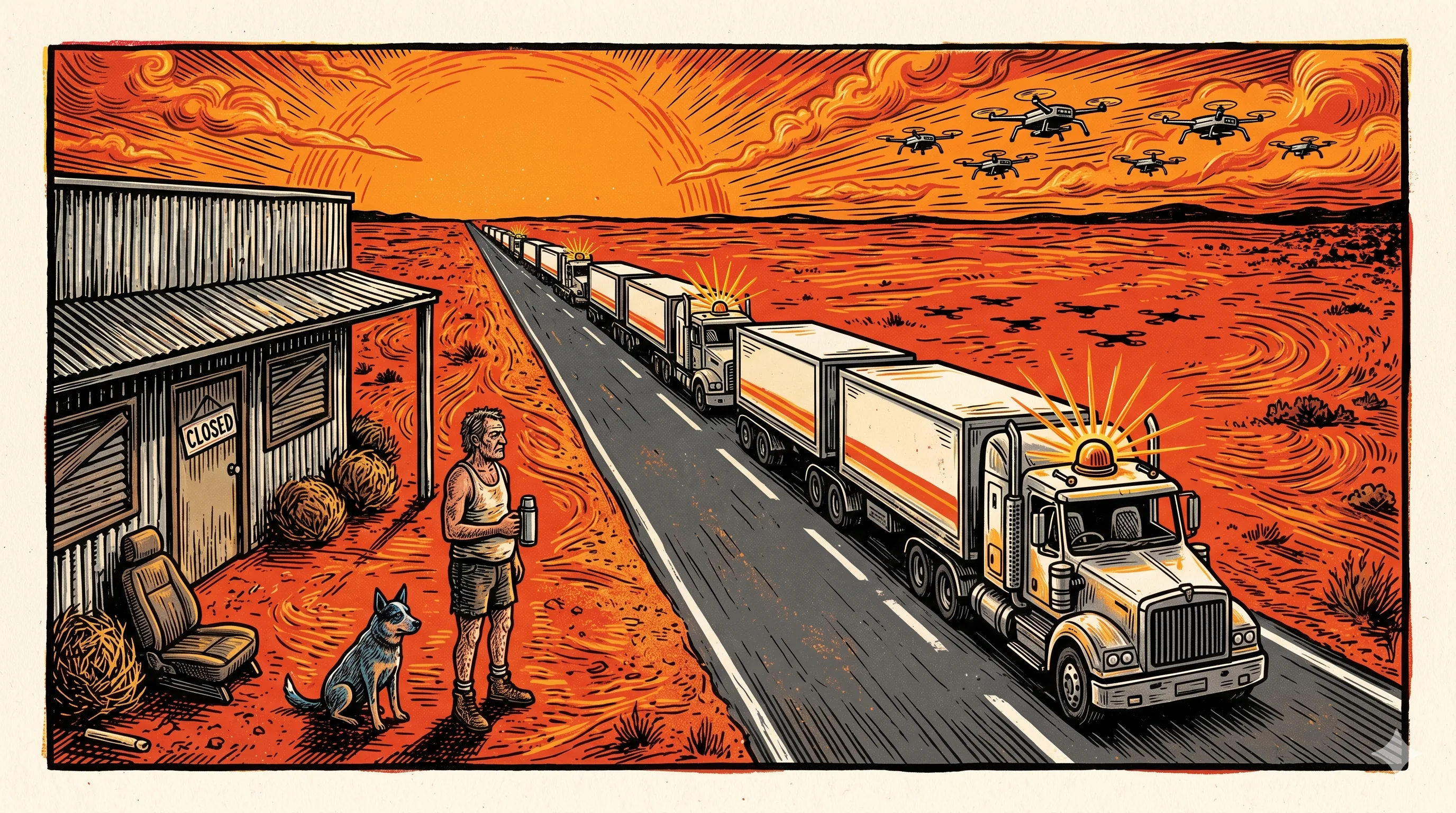
These drivers are not just moving goods. They are sustaining an ecosystem. Every truck that stops needs fuel, food, accommodation, and maintenance. The roadhouse economy along Australia's highways exists almost entirely because trucks need drivers and drivers need to eat, sleep, and refuel.
When the trucks no longer need drivers, the roadhouses lose their customers. And the towns that depend on the roadhouses lose their reason to exist.
The long-haul inflection
Aurora Innovation, Kodiak Robotics, and TuSimple have all tested autonomous trucking on American highways. The core technology works. Highway driving, fuel management, speed regulation, and obstacle avoidance are solved problems, if not yet perfected for every edge case.
Australia's long-haul corridors are simpler than most American interstate routes. The Sydney-Melbourne, Melbourne-Brisbane, and east-west transcontinental highways are well-mapped, well-maintained, and predictable. They are also the most economically significant routes, carrying the bulk of Australia's interstate freight. They will be the first to automate, because they offer the highest return on investment.
The fleet operator calculation is straightforward. A human driver costs $100,000 annually in wages, plus vehicle wear from fatigue-related driving patterns, plus accommodation on multi-day hauls, plus regulatory compliance costs for rest stops and hours-of-service limits. An autonomous truck amortises its capital cost over seven years and runs continuously with minimal labour cost. The robot drives through the night. It does not stop for meals. It does not fatigue. The comparison is not close.
Ports without dockworkers
Australian port automation is already underway, and the results foreshadow what is coming for the broader supply chain.
Patrick Terminals has been automating cargo handling for years. The Port of Brisbane operates semi-autonomous container movers. The Port of Sydney is modernising crane systems. The technology is mature and proven. Container terminals do not need humans moving containers in the stack yard. They need people to inspect, manage exceptions, and supervise the machines.
A fully automated port unloads 5,000 containers per day with five human supervisors instead of 500 workers. Cranes are automated. Yard equipment is autonomous. Customs and quarantine processing is electronic. The Australian port workforce of roughly 20,000 is well-paid, union-protected, and extremely expensive per worker. Automation reduces labour costs by 80 percent while increasing throughput. Port employment falls 70 to 80 percent within a decade. The first wave is underway. The second compresses to skeleton crews.
The last mile empties out
Wing, Alphabet's drone delivery service, already operates in Canberra and Logan, Queensland. Autonomous delivery vehicles are being tested in Melbourne and Sydney. The endpoint is a last-mile delivery system that requires no human drivers at all.
A typical warehouse employs hundreds of people picking, packing, and sorting. Robots now handle most of that work in advanced facilities. A typical delivery depot employs dozens dispatching and managing drivers. Autonomous vehicles eliminate those roles too. The only remaining human function is exception handling: damaged packages, wrong addresses, special instructions.
Wing drones are cheaper to operate than ground delivery. They work in parallel, not sequence. A single warehouse can manage thousands of drone deliveries per day, a coordination task no human dispatcher could handle. The system does not need a human driver because it was not designed with one.
Delivery driving in Australia employs approximately 200,000 people, mostly independent contractors in the gig economy. When drones and autonomous vehicles remove the need for human delivery, these incomes do not transfer to other roles. They evaporate.
The rail precedent, and its limits
Rio Tinto's AutoHaul system in the Pilbara already proves the technology. Fully autonomous heavy-haul rail across 1,700 kilometres, moving iron ore from mine to port more efficiently than human drivers managed. The system is profitable, expanding, and requires fewer human operators every year.
Australian railways carry 400 million tonnes of freight annually. Autonomous rail is proven, profitable, and scalable. If it displaces trucking on major corridors, another 50,000 driving jobs face compression.
But rail connects mines to ports and capitals to capitals. It does not move goods from distribution hubs to regional towns. Trucks do that. And trucks are harder to automate for varied regional routes with complex exception-handling requirements.
Harder, not impossible. Autonomous trucks are coming to regional routes. The timeline is five years for long-haul, ten years for regional. The compression is staggered, not avoided.
The regional collapse
Australia's regional economy is structurally dependent on transport and logistics employment. Towns survive because truck drivers stop, eat, refuel, and stay overnight. Roadhouses exist because drivers need food and rest. Accommodation clusters around highways because of driver demand.
When autonomous trucks eliminate driver stops, the entire service economy follows. Consider a roadhouse on the Newell Highway employing 50 people, almost all of them serving truck drivers. Remove the drivers and you remove the customers. Fifty people lose their jobs. The town loses its spending power. The school loses enrolments. The medical practice loses patients.
Australia's regional communities have experienced this shock before: factory closures, commodity price collapses, drought. The pattern is consistent. Employment goes, population follows, community dies, unless a different economic activity replaces what was lost.
This time the shock is continental. Not one town or one region. Every town on every major highway in Australia. The cumulative effect is a hollowing out of rural and regional Australia at a pace that no government relocation incentive or regional development fund can match.
The workers displaced from truck stops and roadhouses cannot be readily redeployed. There is no parallel job waiting. The infrastructure was designed around a transport labour model that will no longer exist.
All layers at once
The pattern across Parts 3 through 6 of this investigation is convergence. AI improves itself (Part 3). Knowledge worker income compresses (Part 4). Robots eliminate manual labour (Part 5). Supply chains automate end to end (Part 6).
These are not separate phenomena occurring at comfortable intervals. They are parallel expressions of the same exponential curve, arriving in the same five-to-ten-year window, compounding each other's effects.
Government faces a revenue crisis at the exact moment it needs to spend more. The fiscal gap opens from $300 billion to potentially multiples of that figure when physical labour displacement is added to knowledge-work compression. Defence spending commitments cannot be met. Social spending cannot expand. But demand for both explodes.
Every autonomous truck, every robotic warehouse, every orbital server rack needs one thing: electricity.
Part 7
The race for power
AI’s energy appetite, nuclear renaissance, and Australia’s energy paradox.
In October 2024, Microsoft announced a deal to restart Three Mile Island. The reactor that symbolised nuclear catastrophe would return to operation, its output dedicated entirely to powering a data centre for artificial intelligence training.
The deal was not nostalgia. It was desperation disguised as strategy.
The hunger
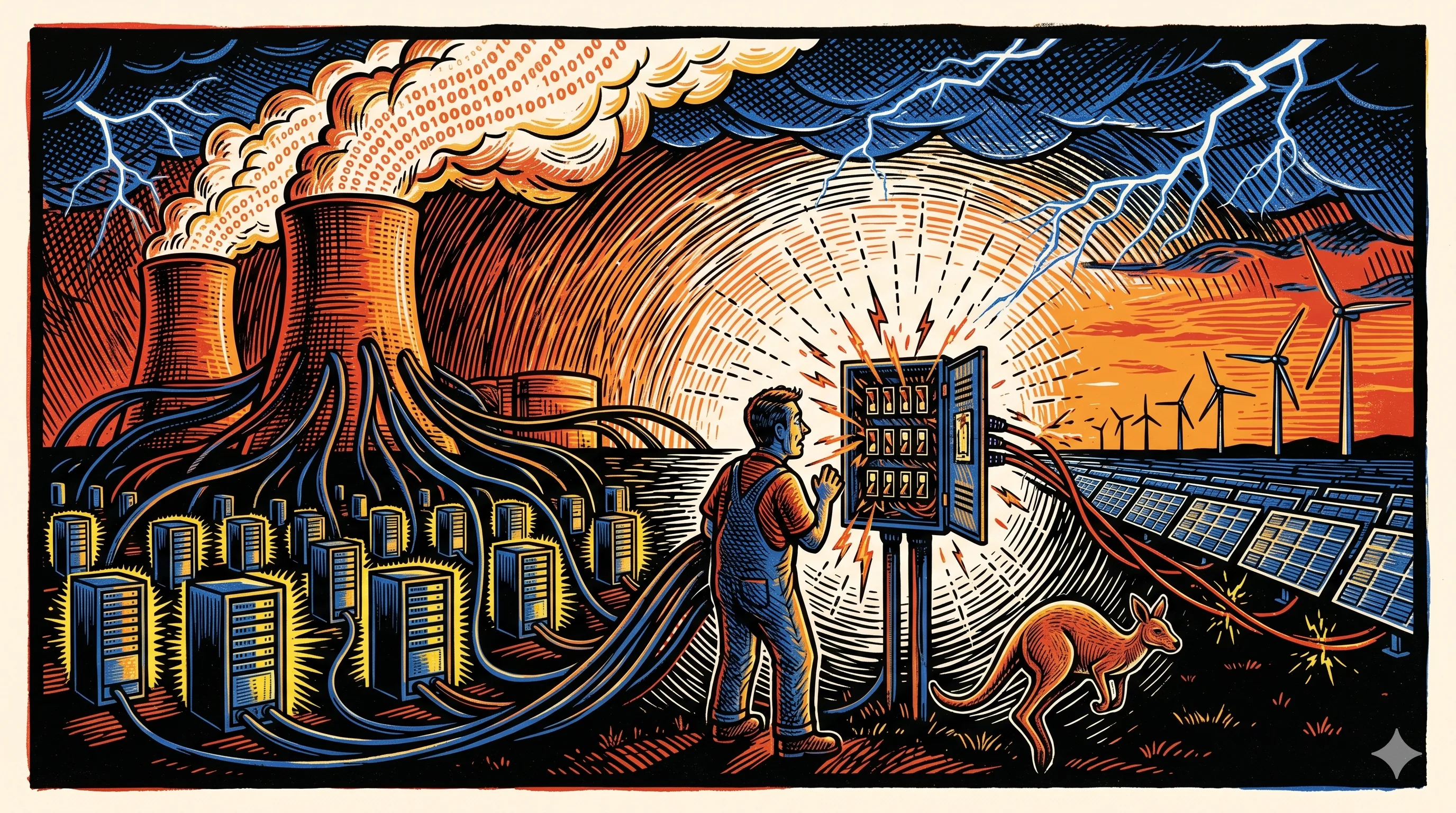
A single frontier model training run now consumes electricity equivalent to a small city's monthly consumption. GPT-4 training required an estimated 50 gigawatt-hours. GPT-5 was multiples of that. The unique constraint: AI training cannot be throttled. It cannot pause and resume cheaply. Electricity must flow continuously, at scale, for weeks or months.
Global data centre electricity consumption reached 460 terawatt-hours in 2023. The International Energy Agency projects this will double by 2028. By 2030, data centres will consume 4 to 6 percent of global electricity, up from approximately 2 percent today. Within a decade, the infrastructure powering AI will rival the electricity consumption of entire nations.
This demand is not linear. It follows the same exponential curve as the capability improvements documented in Parts 1 through 3. Every doubling in capability requires more compute. Every new generation of models is larger, trained longer, and deployed more widely. The electricity to power this expansion does not yet exist.
The nuclear pivot
Over the past five years, nuclear energy has undergone a reversal in perception among energy strategists and venture capitalists. The argument is straightforward: solar and wind cannot reliably power AI at scale. They are intermittent. They require storage (batteries, pumped hydro) that is capital-intensive and land-constrained. Nuclear provides continuous baseload power with near-zero carbon emissions. For companies racing to build AI infrastructure, nuclear is the logical choice.
Microsoft's Three Mile Island deal was followed by Google's partnership with Kairos Power for advanced reactors and Amazon's agreement with Talen Energy for nuclear-powered data centres in Pennsylvania. These are not speculative pilot programs. They are long-term, fixed-price power purchase agreements. Energy is no longer a commodity input for these companies. It is a strategic asset.
Small modular reactors have captured investor imagination. Factory-manufactured, rapidly deployed, and designed for distributed installation. Unlike conventional nuclear plants ($20 billion, ten-year construction), SMRs promise commercial operation by the early 2030s at costs competitive with grid electricity within five to seven years.
Australia participates in none of this. Not because the technology is unavailable. Because the law forbids it.
Australia's paradox
Australia is a world leader in renewable energy deployment. Solar capacity grew from under 1 gigawatt in 2010 to more than 30 gigawatts in 2026. Wind capacity exceeds 12 gigawatts. The cost of Australian solar is among the lowest globally. Vast open spaces, established grid infrastructure, and strong investment conditions.
Yet the National Electricity Market is more fragile than it has been in decades. Summer demand peaks can surge 30 percent in hours. South Australia experienced unprecedented wholesale price spikes in January 2026. Victoria and New South Wales narrowly avoided load shedding during the 2025-26 summer.
The paradox: Australia has world-class renewable resources and a constrained, vulnerable grid. The generation is abundant but distributed, intermittent, and remote. The demand is concentrated in cities. The transmission infrastructure to connect them is decades behind schedule and tens of billions of dollars underfunded.
The Australian Energy Market Operator has identified priority transmission upgrades to unlock renewable capacity. The project list extends decades. Construction requires environmental and planning approvals that add years. Each major transmission line costs $1 to $3 billion per 1,000 kilometres.
Hyperscalers will not locate large AI data centres in remote areas with abundant renewables. They require proximity to existing transmission capacity, preferably co-located with substations or directly connected to generation. The grid connection points that meet these requirements are limited, the land near them scarce, and competition is intensifying.
The prohibition
Australia cannot legally operate a civilian nuclear power station. The Environmental Protection and Biodiversity Conservation Act 1999 contains an explicit prohibition. Decades of political and cultural opposition calcified into legislation.
The Australian Nuclear Science and Technology Organisation operates the OPAL research reactor at Lucas Heights. Civilian nuclear generation is prohibited. Recent government signals suggest a possible shift, but legislative change takes years, and establishing a functioning civilian nuclear industry takes longer still. Regulatory frameworks. Workforce training. Public confidence building. Site selection and approval processes measured in decades, not quarters.
Hyperscalers will not wait. They are building nuclear-powered AI infrastructure in the United States, the United Kingdom, Canada, and France now. Every month of delay in Australian energy policy is a month in which AI infrastructure investment flows elsewhere.
The uranium question
Australia holds the world's largest identified uranium reserves. More than 30 percent of global proven uranium resources are in Western Australia, South Australia, and Queensland. The resource is there. The infrastructure is not.
Australia mines uranium and exports it for enrichment and fuel manufacturing overseas. The fuel is used in reactors globally, generating electricity and revenue for other nations. The arrangement was convenient when nuclear prohibition was a political consensus. In a world where energy is the binding constraint on AI deployment, the arrangement is economically indefensible.
Australia captures 5 to 10 percent of the uranium value chain: extraction and raw material export. The remaining 90 percent (enrichment, fuel manufacturing, power generation, grid revenue) flows to nations with operating reactors. Australia possesses the resource that powers the global nuclear renaissance and derives almost none of the value.
The international environment has shifted decisively. The IAEA actively promotes nuclear expansion as a decarbonisation tool. The United States is streamlining regulatory pathways for SMRs. The United Kingdom and France are expanding capacity. Canada has signalled openness to nuclear resumption. Australia's prohibition increasingly marks it as an outlier among allied nations.
The choice
Australia faces a binary choice on energy. It can remain an energy exporter: shipping refined minerals and lithium for others to convert into AI infrastructure. Or it can capture value domestically by building generation capacity, hosting data centres, and retaining the intellectual property that comes with being a production hub rather than a resource quarry.
The choice is not between nuclear and renewables. It is between sufficient energy to host AI infrastructure and insufficient energy to compete. The combination of expanded renewables, modernised transmission, and nuclear baseload is what every serious energy analysis recommends. Australia is pursuing only one of the three, at a pace that assumes it has decades to act.
It does not. Microsoft has already committed $5 billion to Australian data centre infrastructure. That investment tests the grid's capacity today. If Australia cannot deliver reliable, scalable power, the next $5 billion goes to Singapore, Japan, or the US states competing for hyperscaler investment with nuclear-ready infrastructure.
Energy is the first constraint. The second is the material the chips are made from.

Part 8
The limit of sand
Semiconductors, Taiwan, and the most consequential monopoly on Earth.
Silicon is abundant. Sand contains silicon. The element comprises 28 percent of the Earth's crust. Yet the world's supply of cutting-edge semiconductors is produced by a single company, in a single location, on a single island vulnerable to earthquake and blockade.
Taiwan Semiconductor Manufacturing Company manufactures roughly 90 percent of the world's most advanced processors. Every iPhone processor. Every Nvidia GPU training modern AI models. Virtually every cutting-edge chip designed by Qualcomm, AMD, Apple, or any other company that pushes the boundary of what silicon can do.
This is not a market concentration problem. It is a civilisational single point of failure.
Why nobody else can do what TSMC does
The explanation is not secret technology or government protection, though both play a role. It is accumulated operational excellence across decades of continuous refinement.
Advanced semiconductors operate at the edge of physics. Extreme ultraviolet lithography focuses light at a wavelength of 13.5 nanometres onto photoresist to etch circuitry. Tolerances are measured in individual nanometres. A single impurity or misalignment ruins an entire wafer. Achieving yield rates above 70 percent on advanced nodes is a remarkable feat of engineering discipline. TSMC does it consistently. Competitors struggle.
The equipment comes from a single source. ASML, a Dutch company, is the only manufacturer of EUV lithography machines. When ASML releases a new generation of lithography tools, TSMC buys first, integrates into production, and refines its processes while competitors wait for delivery. By the time Samsung or Intel obtains equivalent machines, TSMC has moved ahead. The lock-in is self-reinforcing.
Samsung is positioned as a distant second. Heavy investment in advanced nodes. Recent progress that has surpassed Intel on some metrics. Yet Samsung's yield rates remain lower than TSMC's. The gap is narrowing but cannot be closed with capital alone. It must be earned through operational learning that accumulates over years.
The CHIPS Act reality
In 2022, the United States allocated $52 billion to restore domestic semiconductor manufacturing through the CHIPS Act. The intention was to attract leading-edge manufacturing and insulate the US from TSMC dependency.
It has not worked as hoped.
Intel, the largest CHIPS Act funding recipient, committed $20 billion of its own capital for fabs in Ohio and Arizona. A staggering investment. Yet Intel's advanced nodes remain behind TSMC in yield rates and efficiency. The gap is not closing at the pace the investment implied. Manufacturing modern chips requires nanometre-level precision, equipment sourced from a handful of global suppliers, and a workforce with decades of accumulated skill. Capital accelerates the process. It does not substitute for experience.
The CHIPS Act fabs are estimated to reach significant capacity by 2027-28 at the earliest. If a Taiwan crisis occurred tomorrow, those fabs would not exist in meaningful production. If the crisis comes in 2030, the new fabs still will not have achieved TSMC's excellence and cannot fully substitute for lost capacity.
The Terafab gamble
Elon Musk announced Terafab as a vertical integration of semiconductor manufacturing into his broader industrial empire. The aim is not merely to supply Tesla's chip requirements but to establish a competitive alternative to TSMC for the broader market.
The vision is coherent. Terafab connects to Musk's orbital compute ambitions: chips manufactured at scale, launched into orbit on SpaceX rockets, powered by space-based solar. If the entire chain works, it breaks every terrestrial constraint simultaneously.
But every element depends on Terafab succeeding at semiconductor manufacturing, and the same obstacles that have humbled Intel and Samsung apply. TSMC's operational excellence is decades in the making. Musk's approach assumes the learning curve can be compressed through capital intensity and engineering aggression. Possible. Not probable.
What Terafab demonstrates, more than its own viability, is that even the most well-resourced actors on Earth recognise TSMC's dominance and are attempting to break it. The fact that the attempt requires this scale of capital and ambition reveals the depth of the moat.
Australia's position: 3 to 5 percent
Australia's role in the semiconductor value chain is raw material extraction. Silicon from quartzite, plus gallium, germanium, and rare earths mined locally or regionally. Australia captures 3 to 5 percent of the value chain. The remaining 95 percent flows elsewhere.
The value progression makes the disparity visceral. Raw silicon: cents per kilogram. Refined semiconductor-grade silicon: slightly more. Wafer fabrication: significant value addition. Photolithography, etching, doping, and dozens of subsequent processes: the value multiplies at each step. Final testing and packaging: more value added. A finished advanced processor that started as a handful-of-cents worth of raw material sells for hundreds or thousands of dollars. TSMC and the companies it serves capture the vast majority of margin.
Australia could theoretically move up the chain. Establish semiconductor design capability. Invest in packaging and testing. Build fabs for legacy nodes, older-generation chip technology that cannot compete with TSMC on advanced processes but serves a large and growing market. Develop sovereign capability in niches where comparative advantage exists.
None of it is quick or easy. Design requires intellectual property access, years of training, and manufacturer linkages. Packaging and testing carry thin margins in a highly competitive market. Legacy node fabs compete on cost against established Asian manufacturers. The Australian government has gestured toward semiconductor sovereignty. AUKUS Pillar II explicitly mentions microelectronics. But AUKUS Pillar II is aspirational, not resourced. There is no $52 billion AUKUS Semiconductor Act. No commitment to fund a fab. The strategy is fragmentary, underfunded, and uncertain.
The Taiwan Strait scenario
The Taiwan Strait is the world's most economically consequential geographic feature. It separates Taiwan from mainland China, which claims sovereignty and has built a military capable of enforcing that claim. Blockade or military action is not hypothetical. Defence strategists routinely model it.
If the Taiwan Strait closes to shipping, the consequences are catastrophic and immediate. Global semiconductor supply stops within days. Every modern computer, smartphone, car, and data centre running AI fails as chips wear out or are exhausted from inventory. Power grids dependent on modern control systems degrade. Communication networks fracture. Economic damage exceeds $10 trillion globally, possibly within a single year.
Australia is vulnerable through multiple vectors. Defence systems built around Taiwanese chips could be compromised. Banking, supply chains, and communications depend on digital infrastructure that runs on those chips. Strategic stockpiles are measured in weeks, not months.
The solution is not building a competitive fab overnight, which is impossible. The solution is strategic redundancy: adequate stockpiles of critical chips, investment in legacy node manufacturing for strategic sectors, diversification of supplier relationships, and niche manufacturing capability to sustain critical functions during severe supply disruption. None happens without sustained government commitment and substantial capital. Neither is forthcoming.
The bottleneck hardens
Despite enormous investment and strategic urgency across the United States, Europe, and Asia, TSMC's dominance is not eroding. ASML's EUV monopoly is not being challenged. Alternatives are making progress measured in years while AI demand accelerates on 90-day doubling cycles.
For AI specifically, the concentration is now a strategic constraint. Companies training the largest models require the most advanced chips. Only TSMC reliably manufactures them at the scale required. If TSMC capacity is fully booked, and it is, AI training is constrained by TSMC's production rate. Nvidia backorders extend years. Leading-edge chips are allocated, not sold on the spot market. The bottleneck will tighten as global AI investment accelerates.
Every terrestrial constraint on AI infrastructure has one potential escape: orbit.
Part 9
The new space race
Orbital compute, satellite filings, and infrastructure above the clouds.
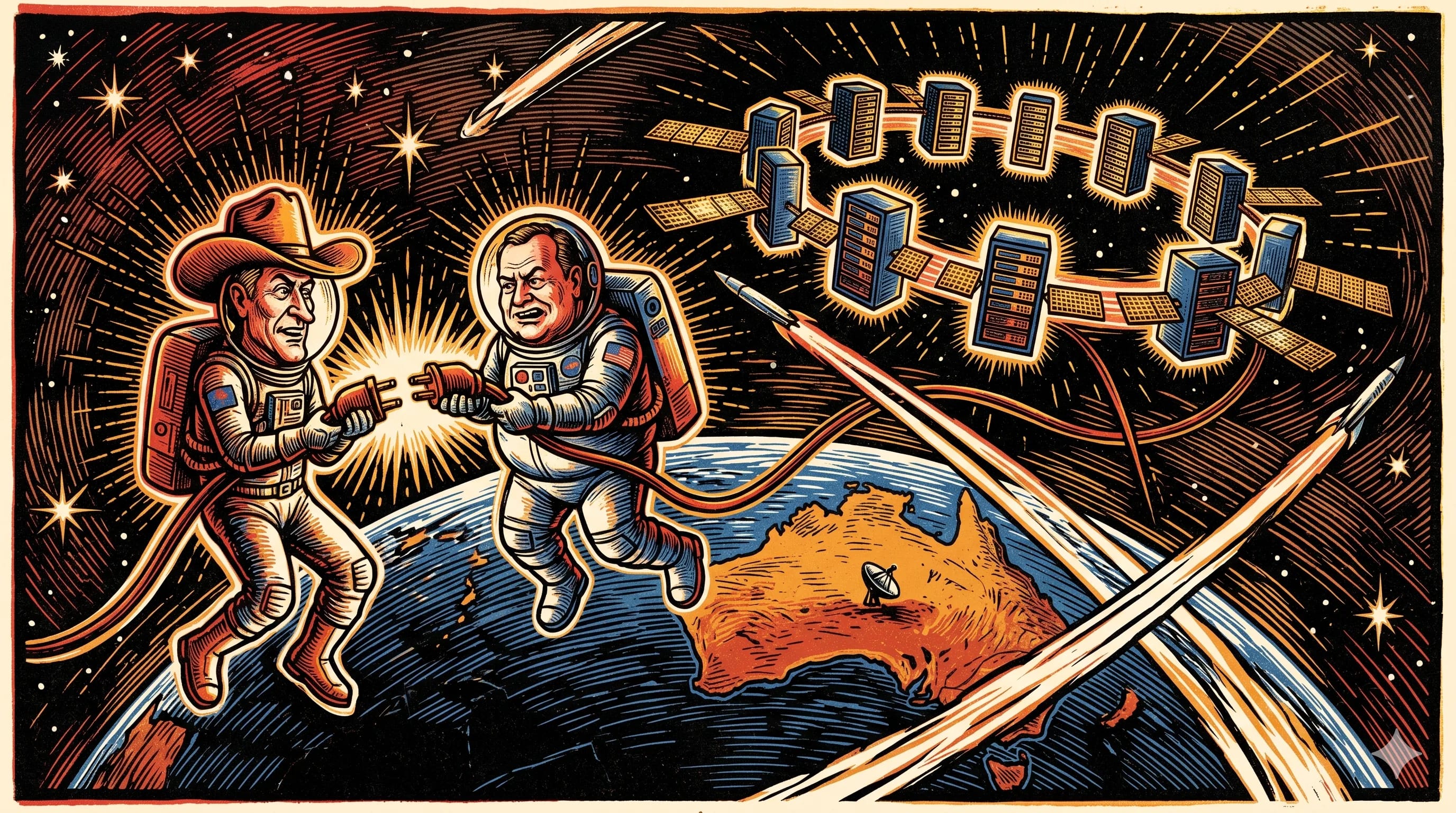
On 30 January 2026, SpaceX filed with the US Federal Communications Commission to deploy a constellation of satellites capable of generating and hosting 100 gigawatts of compute power in orbit.
One hundred gigawatts. Approximately five times the compute capacity of every data centre on Earth combined.
The filing was technical and routine. Its implications are not.
Why orbit makes sense
Space-based compute sounds like science fiction until you examine the constraints documented in Parts 7 and 8 of this investigation. Terrestrial data centres need land, grid connections, cooling infrastructure, transmission lines, environmental approvals, and continuous electricity supply. Each constraint adds cost, delay, and vulnerability. Orbital infrastructure eliminates all of them.
Energy is not a problem in orbit. A solar panel in space receives 1.4 kilowatts per square metre continuously, without atmospheric attenuation, cloud cover, or daily cycling. The sun does not set in orbit. Unlimited, uninterrupted energy at zero marginal cost after deployment.
Cooling is not a problem. The vacuum of space dissipates heat through radiation. No water cooling infrastructure. No cooling towers. No water rights negotiations.
Land constraints vanish. There is functionally unlimited space in low Earth orbit. No zoning regulations, no environmental impact statements, no competing land uses.
Transmission bottlenecks vanish. Orbital data centres serve clients via satellite downlink. No terrestrial grid dependence. No thousand-kilometre transmission lines at $1 to $3 billion each.
If orbital compute becomes sufficiently abundant and low-cost, the hundreds of billions invested in terrestrial data centre infrastructure becomes partially stranded. This is why the SpaceX filing, technical as it was, matters.
The economics of absurdity
Space-based infrastructure was prohibitively expensive for decades. The Space Shuttle cost approximately $54,000 per kilogram to low Earth orbit. At that price, orbital data centres are not a serious proposition.
SpaceX's Falcon 9 reduced launch costs to approximately $1,500 per kilogram. Starship, currently in development, targets $100 to $200 per kilogram. That cost reduction transforms the economic calculus entirely.
A modern hyperscale terrestrial data centre costs $1 to $3 billion, takes years to reach peak efficiency, and consumes $50 to $100 million annually in electricity alone for a 100-megawatt facility. Over a 10 to 15 year operational life, electricity costs alone reach $500 million to $1.5 billion.
An orbital data centre platform requires reusable spacecraft, solar arrays, thermal radiators, computational hardware, and satellite internet downlink capability. If launch costs reach $100 to $200 per kilogram and the platform is reusable, the capital cost per unit of compute becomes competitive with terrestrial alternatives. The operational cost is effectively zero: no land rent, no power bills, no cooling costs, no local taxes, no regulatory overhead.
The operational cost savings over a decade exceed the launch cost by an order of magnitude. This is why Musk is pursuing it. Not as science fiction. As logistics combined with reusable rockets.
Starlink proved the model
SpaceX already operates Starlink, a satellite internet constellation of more than 6,000 satellites. The system works. It generates revenue. It has demonstrated that large-scale orbital infrastructure can be deployed, maintained, and operated commercially.
Starlink provided communications during natural disasters in Japan, Turkey, Syria, and Ukraine. It enabled internet access in remote regions. It proved the economic model for satellite-delivered services at planetary scale.
Orbital compute is Starlink with data centres instead of communications relays. The spacecraft are similar. The maintenance requirements are comparable. The revenue model differs (selling compute rather than internet access) but the operational infrastructure is proven.
The shift is conceptual as much as technical. Computing in space, powered by solar, cooled by vacuum, unconstrained by terrestrial physics. The companies that make this transition first capture an advantage that is extraordinarily difficult to replicate, because replicating it requires the launch capability and operational experience that only SpaceX currently possesses at scale.
Space is contested
Orbit is not an unclaimed frontier. It is increasingly militarised, legally complex, and strategically contested.
Every major power operates military space capabilities. US Space Command, established in 2019, treats space as a warfighting domain. China has invested heavily in anti-satellite capabilities and demonstrated destructive testing. Russia has conducted similar tests. India and Japan have stated space military ambitions.
This creates a sovereignty question that the economic logic obscures. If a nation's AI infrastructure resides in orbit, hosted on satellites over international waters or a potential adversary's territory, whose law applies? Who can seize, disable, or weaponise it?
A company hosting compute in orbit is subject to the laws of the nation that licensed the satellite launch. For US companies using SpaceX, this is straightforward: US law applies. For Australian companies wanting access, or for Australian government critical infrastructure, the situation is more complex. Australia becomes dependent on US-controlled orbital infrastructure, adding another layer to the allied dependency that already characterises its defence and intelligence posture.
Orbital infrastructure also becomes a military target. If a nation's AI infrastructure is in orbit and space is a contested military domain, hosting critical infrastructure there is strategically counterintuitive. The tension between economic logic (orbit solves every cost constraint) and strategic logic (orbit creates new vulnerabilities) will define how nations balance terrestrial and orbital AI deployment over the coming decade.
Australia's space position
Australia is not invisible in space, but it is not a space power.
Pine Gap in the Northern Territory is a joint US-Australian signals intelligence facility, one of the most strategically significant installations in the southern hemisphere. Woomera in South Australia hosts military test ranges. Exmouth in Western Australia tracks US space assets. Australia's geographic position in the Indo-Pacific is valuable for space surveillance and communications, and Australian facilities are crucial to US and Five Eyes operations.
The Australian Space Agency, established in 2018, supports the growth of a domestic satellite industry. Companies like Fleet Space, Myriota, and Gilmour Space are developing and launching small satellites. The industry is nascent but real.
However, Australia has no large-payload launch capability. No orbital manufacturing facilities. No significant commercial space infrastructure at the scale relevant to orbital compute. If AI compute moves to orbit, Australia is initially a consumer of space-based infrastructure from others, primarily SpaceX and US companies. Not a developer. Not an operator. A customer.
AUKUS explicitly includes space cooperation. Australia, the United Kingdom, and the United States have committed to joint space activities. The detail remains vague. What Australia's specific role in allied orbital infrastructure, space-based compute, and space military operations will be is still being negotiated. The negotiation is proceeding at diplomatic pace. The technology is advancing at exponential pace.
The convergence
The last three sections of this investigation trace a single chain. Energy powers the fabs (Part 7). Fabs manufacture the chips (Part 8). Chips launch into orbit to run the AI that is reshaping human society (Part 9).
Each link is a bottleneck. Each bottleneck is being addressed through different strategies. The terrestrial approach (nuclear plants, semiconductor subsidies, grid modernisation) is struggling against physics and infrastructure constraints. The orbital approach attempts to escape those constraints entirely.
For Australia, the convergence presents a choice. Attempt to compete at each bottleneck: nuclear plants matching US investment, semiconductor fabs competing with TSMC, space launch capability accessing orbital infrastructure. This path is extraordinarily expensive and would likely fail at every step.
Or pursue strategic positioning: ensure a role in allied infrastructure, develop niche capabilities where comparative advantage exists, and maintain the security partnerships that provide access to critical infrastructure controlled by others.
The choice is urgent. The window to influence where Australia sits in this chain is measured in the same 90-day doubling cycles as everything else in this investigation.
Orbital infrastructure, semiconductor monopolies, energy politics. These are institutional questions. This final section is personal.

Part 10
What happens to us?
Three scenarios for Australian families, 2028 to 2035.
Parts 1 through 9 of this investigation have described patterns at the level of technology, geopolitics, and economics. The acceleration of AI capability. The concentration of manufacturing in Taiwan. The competition for energy. The race for orbital dominance.
These patterns are real and pressing. But they are also abstract. They describe systems, not people. This final section makes the argument personal.
What does all of this mean for an Australian family with a mortgage, two working parents, children in school, and a 30-year plan that assumed the world would keep working roughly the way it has?
Three futures
The evidence from the preceding nine sections supports three plausible scenarios for Australian families between 2027 and 2035. They are not predictions. They are probability-weighted trajectories, distinguished by how fast institutions adapt to the acceleration documented in this series.
Scenario A: Managed transition
AI grows as forecast. But institutions adapt faster than historical precedent suggests. Retraining programs are rapid, funded adequately, and effective. Workers displaced by AI are retrained within 12 to 18 months and redeployed into roles that complement AI capability. Tax mechanisms adjust: productivity gains are captured through new forms of AI-value taxation. Government revenue is maintained or grows. Social safety nets prove adequate. The housing market adjusts gradually. The dual-income assumption holds, even if the composition of those incomes changes.
Education pivots rapidly. STEM is reframed as working alongside AI, not competing with it. Regional Australia receives targeted stimulus that prevents catastrophic local collapse.
Outcome: disruption but not catastrophe. Inequality increases moderately. Most families experience the transition as a major life event comparable to a recession: stressful, materially significant, but survivable. A new normal accepted by 2032.
This scenario requires extraordinary institutional capability, decisive government action, and private sector cooperation. It is possible. It is not the default.
Scenario B: Structural lag
AI grows as forecast. Displacement occurs rapidly. But institutional response lags. Government debates for months while workers are displaced in weeks. Retraining programs are announced but underfunded, reaching only 30 to 40 percent of affected workers. The remainder compete for a shrinking pool of roles. Wages fall.
Knowledge workers find work at 60 to 70 percent of their former income. Unemployment spikes to 8 to 12 percent for a year or two, then settles at 6 to 8 percent. Tax revenue falls. Government services contract. Healthcare and education quality degrade.
The housing market comes under real stress. Dual-income households lose one income. Mortgage stress rises sharply. Interest rates do not fall (inflation remains elevated, the central bank holds tight). Some households face forced sales. Defaults surge. Housing prices stagnate in real terms for five to seven years. Some regions see 15 to 20 percent declines.
Income inequality surges. Workers displaced from professional roles earn 30 to 40 percent less in their next position. Wealth inequality worsens as asset-rich households weather the storm while income-dependent households do not.
Regional Australia is hit hard. Single-industry towns lose 10 to 20 percent of their population within five years as the transport and logistics jobs documented in Part 6 disappear.
By 2031-32, the worst is past but the scars are visible. Most families have lower real income than in 2026. Most have lower net wealth. Most regional communities are smaller. Stability has returned, but material prosperity is 10 to 15 percent below the no-disruption trajectory.
This is the default scenario. What happens if institutions respond adequately but not exceptionally.
Scenario C: Unmanaged disruption
The doubling time accelerates beyond 2026 trends. Recursive improvement, documented in Part 3, pushes capability faster than forecast. AI reaches what 2032-33 models were expected to achieve by 2028-29.
Displacement accelerates. Unemployment spikes to 15 to 25 percent within years, far faster than Scenario B. Government policy is overwhelmed. Retraining is inadequate. The labour market seizes. Vacancy rates collapse. Wage compression is severe.
The top 10 percent of earners, in AI-resilient occupations, see incomes rise. The bottom 40 percent see incomes collapse. The middle class is crushed between rising costs and falling wages.
Tax revenue collapses. The government hits a fiscal cliff. Healthcare and education are slashed. Defence spending is pressured. Emergency services are constrained. The government chooses between massive spending cuts and debt issuance. It attempts both.
The housing market correction is severe. Dual-income households lose income faster than they can adjust. Forced sales accelerate. Defaults surge. Banks face large enough losses that government intervention may be required to prevent a banking crisis. Housing prices fall 30 to 50 percent in real terms. Entire neighbourhoods enter negative equity. A generation's savings are obliterated.
Regional Australia approaches collapse. Population declines of 30 to 40 percent in three to four years. Schools, hospitals, and banks close. People who cannot leave are stranded.
By 2030-31, the situation stabilises at a much lower level. Thirty to 40 percent of the working-age population is not in the labour force. Government capability is degraded. Public confidence in institutions is shattered.
This is a genuine systemic crisis comparable to the Great Depression, compressed into a shorter timeframe. Recovery takes a decade or more. It is the worst case, less likely than Scenario B, but more plausible than conventional analysis acknowledges.
The mortgage question
Australian family finances are structured around an assumption now in question: the dual-income household as norm.
The average Australian mortgage is $620,000. Approximately 75 percent of lending assumes dual-income servicing. Two earners, each bringing in $70,000 to $150,000, comfortably service a $600,000 to $800,000 mortgage at current rates.
The mathematics become unforgiving when one income disappears. A household earning a combined $200,000 can service a $600,000 mortgage at 5 percent with room to spare. A household earning $100,000 cannot. A household where the displaced earner retrains and returns at $70,000 is in mortgage stress, defined as spending more than 30 percent of net income on housing costs.
In Scenario B, 15 to 25 percent of dual-income households experience this calculation. In Scenario C, the proportion is dramatically higher. The banking system has a vested interest in elevated housing prices because defaults are costly. The magnitude of the problem depends on how many households are stressed simultaneously. In Scenario B, enough that government must intervene with support programs. In Scenario C, enough that the banking system itself is threatened.
Every family should ask now: what is our income dependency? If two of us work, can we assume both will indefinitely? What financial buffer exists if one income stops? Can we reduce spending quickly? These are not anxious questions. They are prudent ones for a period of transition.
The education question
Parents making education decisions in 2026 and 2027 face a question without historical precedent: what should my child study if AI can do most cognitive work by the time they graduate?
The traditional answer has been to study something difficult that requires high cognitive ability, because jobs demanding that ability pay well. That logic breaks when AI performs cognitive work better and more cheaply than humans.
Several categories of human capability remain durable, at least within the timeframe of this investigation.
Interpersonal skill: understanding people's needs, communicating effectively, building trust. Therapists, teachers, nurses, and childcare workers whose work depends on human connection and emotional attunement. AI does not do this well.
Creativity and novelty: imagining new things, creating meaning, producing something that has not existed before. AI assists, but human judgment about what is worth creating remains distinctly human.
Leadership and judgment: making decisions under uncertainty, taking responsibility, navigating complexity when the stakes are real and the data is incomplete. Hard to automate.
Physical skill: working with hands, building, repairing, moving effectively in physical space. Despite the robotics advances documented in Part 5, embodied skill in varied environments remains difficult for machines.
The educational implication: invest in interpersonal development, arts, creativity, practical skills, and physical capability. Do not abandon STEM, but reframe it: STEM as a tool to understand the world and work alongside AI, not as a guaranteed pathway to a lucrative career. Children who will thrive are those who can do things with people and with their hands, not children who try to outthink AI systems.
This is a fundamental reorientation of educational thinking. Australian schools, universities, and parents are still oriented toward a pre-AI paradigm. The advice most children receive today, to study STEM, to aim for prestigious professional careers, is advice for a labour market that is evaporating. The reorientation has not occurred at scale because the institutions that would drive it are operating on the same slow timescales as every other institution documented in this series.
What you can do
Seven actions. None extraordinary. All prudent.
Build AI fluency now. If your job is at risk, learn how AI works in your domain. Learn to use AI tools. Learn to direct them. The people who thrive in transition are not those who resist AI but those who master its use. An hour per week. By 2028-29, when the pressure becomes acute, you will have a year or two of advantage over peers who waited.
Diversify income. If your household depends on a single source, reduce the dependency. Can the other partner develop an income stream? Can you monetise a skill independently? Multiple part-time income sources provide insurance that a single salary does not.
Reduce debt. If you carry a mortgage, pay it down where possible. The goal is not to become debt-free but to reduce debt service as a percentage of income. A $300,000 mortgage is serviceable on $70,000. A $600,000 mortgage is not. If you cannot reduce principal, ensure your rate is fixed for the longest available term.
Build skills AI augments, not replaces. Ask what your job requires that AI cannot do. If the answer is "nothing," your job is at risk. If the answer is "communication, judgment, creativity, physical skill," your job is more resilient. Develop those capabilities deliberately.
Invest in community. Social capital is the only asset AI cannot erode. Networks, relationships, trust, and mutual support are irreplaceable and cannot be automated. They are built over years through community groups, churches, voluntary organisations, and local associations. Invest time, not money, in local relationships. Strong community is social insurance that money cannot buy.
Ensure children are literate and numerate. Not brilliant. Able. Can read well, understand mathematics, and communicate clearly. Specific careers will change. Foundational capabilities endure. Support literacy and numeracy above everything else.
Stay mentally and physically healthy. The period from 2027 to 2032 will be stressful under Scenario B and catastrophic under Scenario C. Mental and physical resilience are necessities, not luxuries. Exercise, sleep, social connection, and psychological support infrastructure are not optional.
What institutions should do
Families can prepare. But the scale of the challenge documented in this investigation exceeds what individual preparation can address. Institutional response is not optional.
Government should establish rapid retraining programs now, not in 2027. Target the 15 to 20 percent of the workforce most vulnerable to AI displacement. Design programs that are intense, practical, three to six months long, funded adequately, and connected to employment outcomes. The JobTrainer model during COVID showed the mechanism. The scale needs to be dramatically larger.
Business should recognise that employee stability is in its interest. Retraining current employees is cheaper and faster than hiring new ones. Companies investing in their workforce now build loyalty and capability that will differentiate them as the transition intensifies.
Educators should reorient curriculum. Universities should stop assuming domain expertise is automatically transferable to employment. Schools should stop assuming STEM is the sole pathway to prosperity. Invest in interpersonal skills, creativity, physical capability, and leadership. Institutional change of this kind takes five to ten years. It must begin now.
Community organisations should recognise that their role in building social capital is more important than it has been in decades. As labour market stress increases, community infrastructure becomes the shock absorber. Invest, strengthen, and make accessible.
The preparation window
This investigation began with a pattern: eight AI releases in 26 days. A capability doubling clock ticking every 90 days. A recursive improvement loop that accelerates the clock itself.
It traced the consequences across Australia's fiscal system, its labour market, its physical economy, its energy grid, its semiconductor supply chain, and its strategic position in the emerging orbital infrastructure race.
Each section added evidence. Each section narrowed the question. Not whether disruption is coming, but whether institutions and families can adapt before the window closes.
The window is 2026-27. By 2028, AI will have doubled twice more. Options that are available today will be harder to exercise. Skills that can be built now will take longer to develop later. Debt that can be reduced now will be harder to manage if income compresses. Communities that can be strengthened now will be harder to rebuild if they fracture.
The patterns are clear. The acceleration is real. The infrastructure vulnerabilities are genuine. The labour disruption is coming. Only the question of preparation remains. And preparation is still possible.
But the clock is ticking. And it does not wait.
Standards
Methodology.
Every claim in Outpaced is sourced. Statistics link to primary data. Where estimates are used, they are clearly labelled as such. The investigation draws on published research, company filings, government reports, and peer-reviewed analysis.
This is not prediction. It is pattern recognition. The trends documented here are already underway. The only question is speed.
Stay informed
Subscribe to Leverage
Strategic analysis of AI acceleration delivered to your inbox.
Join readers of Leverage