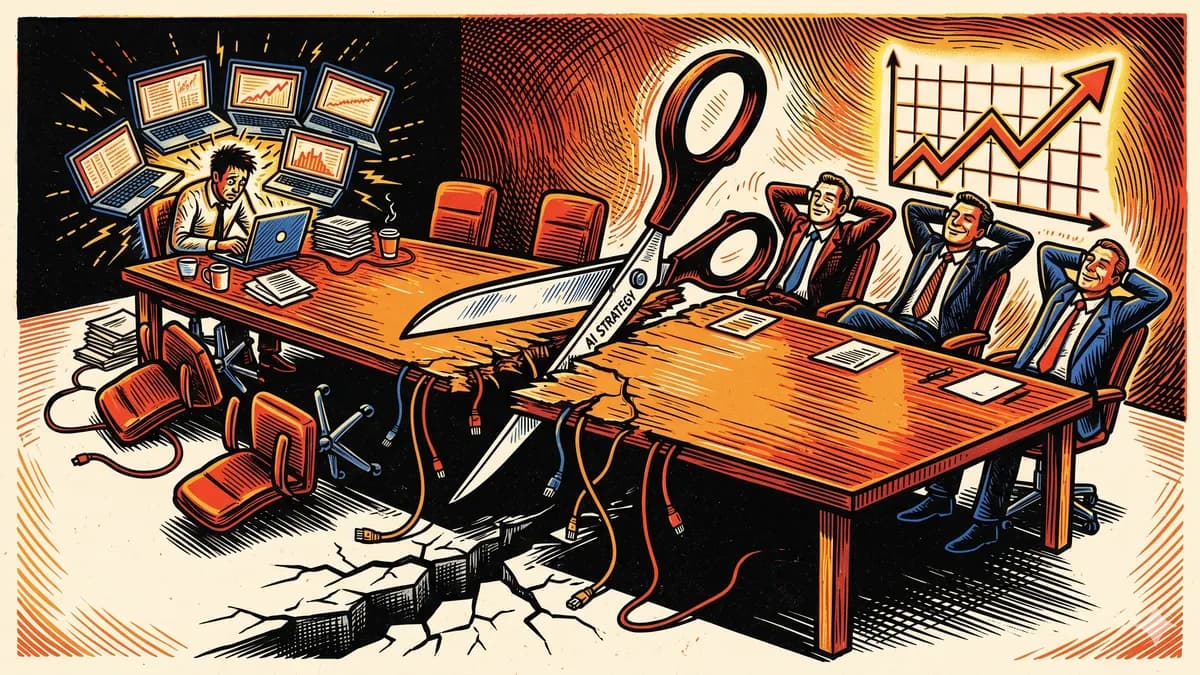

Gartner surveyed 350 executives at companies with revenues above a billion dollars, all of them piloting or deploying AI at enterprise scale. Eighty percent had cut staff. The analyst who ran the study, Helen Poitevin, put the finding plainly: the companies reporting the highest returns from AI were not the ones that cut the most people. Workforce reductions, she said, create budget room. They do not create return.
That finding landed on 5 May 2026, the same week tech layoffs for the year passed 142,000. Meta had just notified 8,000 employees that their positions no longer existed. Intuit cut 3,000. Cloudflare cut 1,100. Upwork announced it was eliminating a quarter of its entire workforce. All of them are profitable. All of them framed the cuts as funding the AI transition.
A dominant corporate logic has taken hold: cut headcount, redirect the savings into AI infrastructure, collect the productivity dividend. It sounds clean. It looks decisive on an earnings call. And the data, from the largest analyst firm in the world, says it does not work.
The J-curve nobody budgeted for
The reason is structural, and it has a name. Economists call it the J-curve: the pattern where productivity drops after a new technology arrives, stays down while organisations absorb the cost of learning, and only recovers once the workforce, the processes, and the infrastructure have been rebuilt around the new tool. The curve is shaped like a J because the dip comes first and the payoff comes later. Every major technology wave has produced one. AI is producing a steep one.
The evidence is consistent across settings. MIT Sloan researchers, working with US Census Bureau data across tens of thousands of manufacturing firms, measured an average productivity drop of 1.33 percentage points in the years immediately following AI adoption. The firms that recovered did so over the four-year study window, and recovery only materialised in companies that were already digitally mature before they started. METR, a nonprofit research lab, ran a randomised controlled trial with experienced open-source developers and found that access to AI coding tools made them 19 percent slower, not faster, even though the developers themselves believed they were 20 percent quicker. A February 2026 National Bureau of Economic Research survey of 6,000 executives found that the vast majority of companies saw no productivity impact from AI at all.
DORA's 2026 developer productivity report named three causes for the dip: the learning curve (people adjusting workflows around new tools), the verification tax (time spent reviewing AI outputs for accuracy), and pipeline adaptation (rebuilding processes to accommodate AI-generated work). None of these are optional. All of them require people with deep professional and technical mastery of their roles.
This is the part that the cut-and-deploy playbook gets wrong. The J-curve is not a temporary inconvenience on the way to automation. It is a period of intensive human investment: reskilling, process redesign, institutional learning. The recovery does not arrive with time. It arrives with effort. And effort requires a workforce.
When a company fires 20 percent of its people and then enters the J-curve, it has fewer hands to absorb the learning, fewer minds to verify the outputs, and fewer institutional relationships to redesign the processes. The remaining employees are not freed up by AI. They are loaded up by the absence of their colleagues and the demands of tools they have not yet learned to trust.
The survivors are not fine
The evidence on what happens to the remaining workforce is now substantial and consistent across multiple studies.
UC Berkeley researchers spent eight months inside a 200-person technology company studying what happened when workers genuinely embraced AI. They expected to find people working less. They found the opposite. Employees who adopted AI tools did not reclaim the time saved. They filled it. Work expanded into lunch breaks and late evenings. The researchers called it workload creep: without intention, AI makes it easier to do more but harder to stop. The employees who leaned in hardest, who mastered the prompts and evangelised the tools, showed the earliest signs of burnout.
BCG formalised this in a study of 1,488 workers published in Harvard Business Review in March 2026. They gave the phenomenon a name: AI brain fry. Fourteen percent of the workers they studied reported it. Those with brain fry experienced 33 percent more decision fatigue. Minor errors rose 11 percent. Major errors rose 39 percent. And the intent to quit among affected workers was 39 percent higher than the baseline.
The productivity cliff is measurable. BCG found that output peaks at three simultaneous AI tools. Beyond that threshold, the cognitive overhead of monitoring, verifying, and switching between AI outputs exceeds the capacity of the person doing it. Performance does not plateau. It drops.
McKinsey's own survey of nearly 13,000 workers across 16 industries confirmed the pattern at scale: 55 percent of heavy AI users reported burnout symptoms, compared with 32 percent of the full sample. Half of those heavy users planned to quit within three to six months.
So the sequence that corporate boards are approving looks like this: cut staff to fund AI, load the survivors with the cognitive cost of adoption, watch the most capable adopters burn out and leave, then wonder why the ROI dashboard stays flat.
The strategy is eating its own workforce.
The amplification gap
The Gartner data contains a second finding that has received less attention than the headline. The companies that did report high ROI from AI were not cutting staff. They were investing in their people: retraining, redesigning roles, building the operating models that let humans guide and scale autonomous systems. Poitevin called it amplification. The distinction matters.
Writer's 2026 Enterprise AI Adoption survey of 2,400 workers put a number on the gap. Fewer than three in ten organisations reported significant ROI from generative AI or AI agents. Yet seven in ten C-suite leaders confirmed their companies were doing layoffs because of AI. And four in ten of those same leaders admitted they had no formal strategy to generate revenue from the tools they had bought.
That last figure is the one that should alarm shareholders. Four in ten companies cutting staff for AI do not have a plan for how AI will make money. The cut is the plan. The headcount reduction is being reported as the return. I spent 26 years in institutions where the budget line was always the constraint and the people were always the multiplier, and I can tell you what happens when you invert that relationship: you get a capability gap that compounds quarterly, because every person who walks out takes institutional knowledge with them that no large language model has been trained on.
The survivor-syndrome research has been measuring this for decades, long before AI entered the picture. Research on survivor syndrome shows a 41 percent drop in job satisfaction and a 20 percent decrease in performance among employees who survive a layoff round. The combination of guilt, insecurity, and expanded workload suppresses exactly the kind of discretionary effort that AI adoption depends on. You cannot ask someone to experiment with a new tool, tolerate its errors, and redesign their workflow around it while they are simultaneously wondering whether the next round of cuts will include them.
The doom loop
Connect the Gartner finding to the burnout data and a pattern emerges.
The J-curve requires human investment to climb out of. Layoffs remove the people who would make that investment. The survivors absorb more work, burn out faster, and either leave or disengage. The AI implementation stalls because nobody has the bandwidth or the psychological safety to push through the learning curve. The ROI stays flat. The board, seeing flat ROI, approves another round of cuts.
That is not a strategy. It is a feedback loop that tightens with every iteration. And 142,000 people have been fed into it this year.
MIT's longitudinal data shows what happens to companies that do the opposite: invest through the dip, retrain instead of remove, treat the J-curve as a transformation cost rather than a line item to eliminate. Those firms outperformed their peers in both productivity and market share. Not eventually. Within the study window.
The cut is not a strategy. It is a sugar hit: a press release dressed as a plan, designed to boost short-term earnings while bleeding out the corporate knowledge and workforce trust that no AI system can replace. Every person walked to the door takes context, relationships, and institutional memory that never made it into a training set.
These companies call it an AI strategy. The spreadsheet tells a different story: fewer names, same targets, no plan for what the tools are supposed to produce. A real strategy would give their workforce artificial leverage, not an exit interview.